





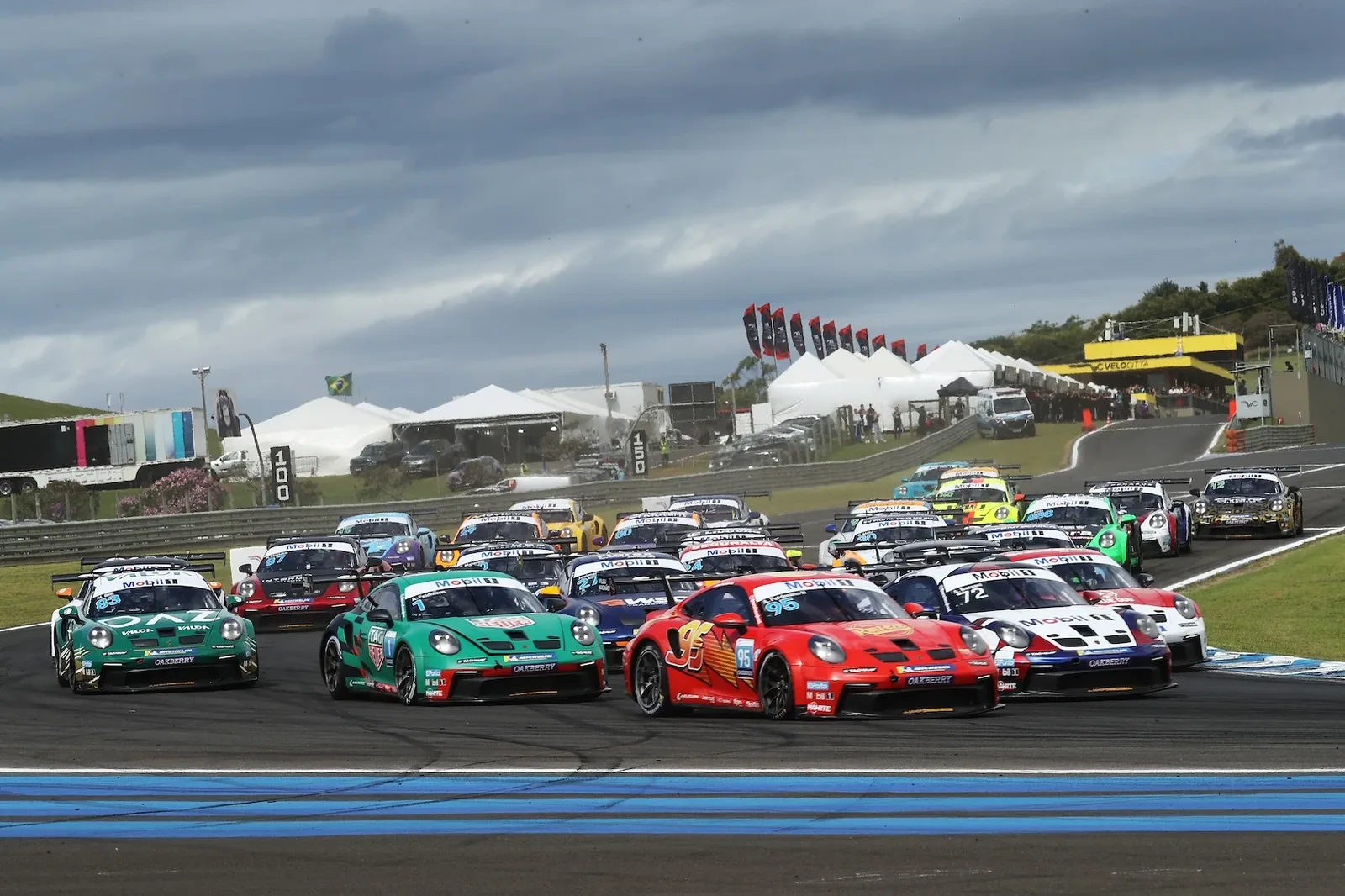
The Porsche Cup Brasil will write a new chapter in its history in 2026, during the week of June 10 to 13. For the first time, the category will hold its international stage at the La Sarthe circuit, as the official preliminary event of the traditional 24 Hours of Le Mans in France. For Fremax, the official supplier of brake discs for the category for 20 consecutive seasons, the race also represents a symbolic reunion with the origin of the main revolution in braking systems in motorsport.
Read more Rafael Câmara races in Monaco and aims for the lead in the Formula 2 championship
It was precisely at Le Mans, in 1953, that disc brakes were used for the first time in a major international race – and the innovation was decisive for winning the race. On that occasion, Jaguar surprised the paddock by equipping its C-Type prototypes with a technology until then mostly used in aviation. In an era dominated by drum brakes, discs presented a decisive advantage: they withstood much higher temperatures without significant loss of efficiency – and without the need for replacement during pit stops.
The impact was immediate. Jaguar cars began braking later along the long straights of La Sarthe and dominated the race, finishing first, second, and fourth. That year, Le Mans recorded for the first time an average speed exceeding 100 miles per hour (160 km/h) over the 24-hour race, consolidating disc brakes as the new performance standard in world motorsport.
The innovation quickly surpassed the limits of the tracks. In 1955, the Citroën DS 19 became the first mass-produced car equipped with disc brakes. Shortly after, Formula 1 also began adopting the technology, achieving its first victory with the system in 1957, when Stirling Moss won the British GP with Vanwall.
In Brazil, Fremax has been manufacturing premium brake discs and auto parts for 40 years, recognized for quality and safety in the most demanding automotive markets worldwide – supplying more than 70 countries with its technology.
Porsche Cup Brasil at nearly 300 per hour – More than seven decades after the overwhelming debut of disc brakes, La Sarthe remains one of the greatest possible challenges for any braking system. With 13,629 meters in length — more than three times the length of Interlagos — and no less than 38 corners, the French circuit will have the highest average speed of the entire Porsche Cup Brasil season. Simulations carried out with the Porsche 911 GT3 Cup generation 992.1 indicate lap times around 4min01s, with an average speed exceeding 203 km/h.
The layout is marked by long periods of maximum acceleration – where Porsche Cup Brasil cars can approach 300 km/h – interspersed with extremely severe braking zones. The most emblematic section is the Mulsanne straight, six kilometers long, interrupted by two chicanes. At the first, cars reach 290 km/h before decelerating to 109 km/h in a 4.6-second braking covering 265 meters. At the second chicane, the reduction occurs from 285 km/h to 112 km/h over approximately 210 meters. Approaching the Mulsanne corner, cars reduce from 276 km/h to just 85 km/h after more than five seconds of braking.
Read more F1: Ben Sulayem reinforces plan for the return of V8 engines
Speeds are also impressive in other sectors of the circuit. Before the Indianapolis corners, cars reach up to 292 km/h, while the Porsche corner sequence is taken at speeds above 180 km/h. Throughout the lap, estimates indicate longitudinal braking forces between 1.5G and 2.3G.
Another important differential for the French stage is the use of the ABS system in Porsche Cup Brasil cars. In previous experiences with the 992.1 model at Le Mans, such as in the brand’s European categories, cars competed without anti-lock assistance. With ABS, the expectation is for even more aggressive and efficient braking at corner entries.
“Le Mans is a circuit that combines very high speeds with extremely demanding braking zones. The discs work under severe temperature and load conditions practically all the time, especially because decelerations always start from very high speeds,” explains Jaison Picoli, Engineering Coordinator at Fremax.
“The technical challenge is precisely to maintain performance stability throughout the lap, ensuring consistent response even after very long and intense braking. The ABS present in Porsche Cup Brasil cars also allows further exploration of the braking potential of the setup,” adds the engineer.
The category’s cars use slotted discs developed by Fremax, a solution that helps clean the contact surface with the pads during braking, eliminating gases and residues generated under high temperatures. The Carbon+ composition, with a high carbon content, also favors thermal dissipation and increases resistance to fading under extreme usage conditions.
Exceptionally, the Le Mans stage will feature only Carrera Cup cars, using the Porsche 911 GT3 Cup generation 992.1. The schedule includes two races at the French circuit: the first on Thursday (11) and the second on Saturday (13) – both lasting 45 minutes each.
Read more F1: Leclerc relives iconic victories with Ferrari after renewal