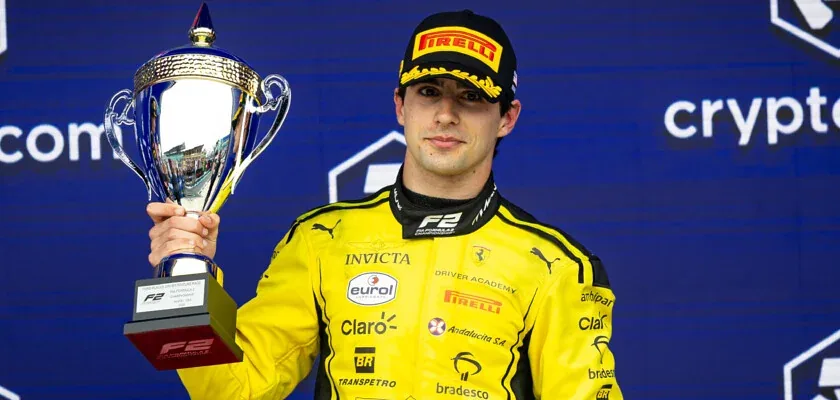






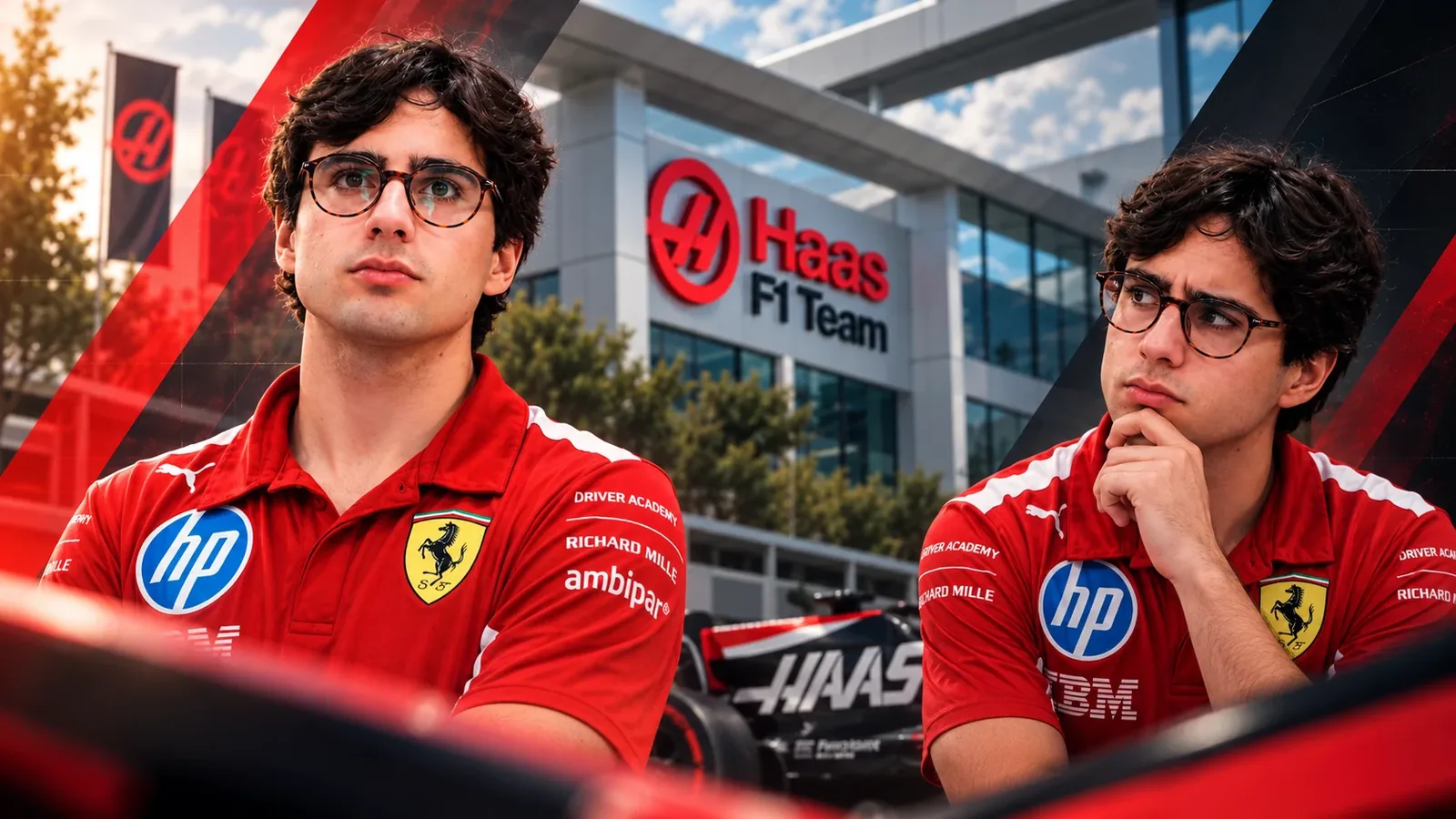
Brazilian combines performance, Ferrari support, and good results in Haas tests, but the team has not yet announced its 2027 lineup; the scenario allows for a very convincing prediction, not a confirmation.
Read more Tito Giaffone highlights challenges to get the car right on the Curvelo oval
Rafael Câmara will be Haas driver in Formula 1 in 2027. Very possibly.

And it is precisely this “very possibly” that must accompany any serious discussion about the Brazilian’s future at this moment. Not because there are no reasons to believe that Câmara is very close to Formula 1. On the contrary. When all the pieces are laid out on the table, it may even be harder to build an argument against his promotion than to explain why it should happen.
The Brazilian is in his debut season in Formula 2, competing for the championship lead with Nikola Tsolov, belongs to the Ferrari Driver Academy, has been prepared by Ferrari itself with tests of previous cars, and recently participated in the evaluation conducted by Haas in Portimão. The American team, in turn, has not yet officially defined its lineup for 2027 and is evaluating alternatives given the possibility of Esteban Ocon leaving the team.
There are published reports that Câmara performed extremely well in this test. Some outlets have already named him as the chosen one. There is a technical relationship between Ferrari and Haas that makes his arrival perfectly logical. There is also a driver market pointing to a real opportunity.
What there isn’t is an announcement from Haas. That difference may seem small. In journalism, it is not.
A signing announced before the test
Perhaps the best way to understand this story is to go back a few weeks. Even before Câmara got into the VF-25 in Portimão, an Italian publication had already treated his arrival at Haas as decided. The information began circulating in July and quickly crossed borders. In Brazil, different outlets echoed the possibility of the country having two full-time drivers in Formula 1 in 2027.
At that time, however, there was no confirmation from Haas. And later information showed that the team itself would still conduct an evaluation process involving different candidates.
This does not necessarily mean that information was wrong. It is perfectly possible that Câmara was already very well advanced internally or that there was a preference within the negotiations. It is also possible that the Italian source received real information about moves that were not yet finalized.
But there is a difference between having insider information and having official confirmation. And there is another difference, perhaps even more important, between information and analysis.
Because anyone closely following the Haas scenario could build a very convincing argument in favor of Câmara even without having a single source inside the team.

The “BBB” of Haas
Then came Portimão.
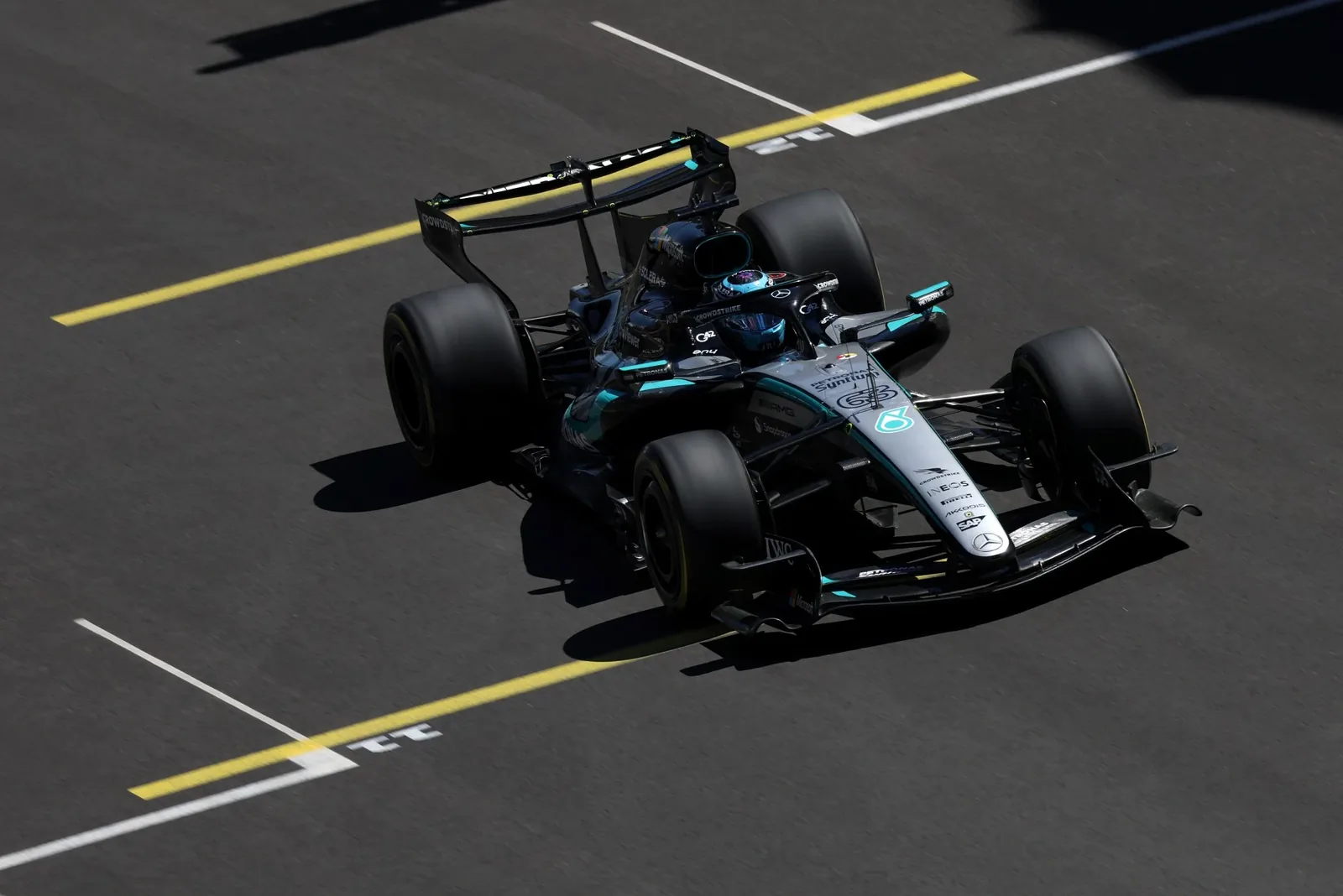
Between August 26 and 28, Haas put Rafael Câmara, Leonardo Fornaroli, and Ryo Hirakawa in the VF-25 in a test with previous cars. Oliver Bearman also participated in the activity and set a benchmark for the evaluated drivers.
It was practically a selection. Or, as we joked on F1Mania Em Ponto, a kind of Haas BBB: different candidates, a Formula 1 car, and a spot that may appear for 2027.
The comparison, obviously, is a joke. The work done by the team is much more complex than simply looking at a timing sheet. In tests like this, speed, adaptation, consistency, communication with engineers, development capability, behavior with different setups, and a series of elements that do not appear to outside observers are evaluated.
And there is a fundamental detail: Haas did not release the test times.
Publicly, therefore, there is no official classification saying that Câmara won the comparison.
After the activity, however, insider information began to appear. ge published that Câmara not only was the best among the candidates but also surpassed the benchmark set by Bearman, impressing the team with speed and technical feedback. Other outlets also began to point to the Brazilian as the highlight of the evaluation.
This is relevant information and should be considered.
But it remains information obtained by the press about a closed test, not a result published by Haas.
Was it that surprising?
There is still a question that may be overlooked in this story. Câmara performing very well in Portimão should not exactly be surprising.
He is a 21-year-old active driver, competing in the Formula 2 season, and arrives at the test after a series of works with Formula 1 cars. Ferrari has been investing directly in his preparation, progressively increasing his mileage and familiarity with the main category’s equipment.
Fornaroli has great quality and resume. Hirakawa has experience, mileage, and an extremely important connection with Toyota. But Câmara is exactly at the career moment when a driver needs to show he is ready for this leap.
And, according to the information that emerged after Portimão, he apparently did.
If the criterion were exclusively speed and sporting potential, it would be very difficult to look at the process carried out by Haas and not put the Brazilian in a privileged position.
But a spot in Formula 1 is almost never decided exclusively by the stopwatch.
Ferrari on one side, Toyota on the other
That’s where the competition gets more interesting.
Câmara does not come alone. Behind him is Ferrari.
The Brazilian is part of the Ferrari Driver Academy and Maranello has been following his development since the junior categories. The relationship with Haas makes this connection especially relevant: the American team uses Ferrari power units and maintains a long technical partnership with the Italian manufacturer.
On the other side is Toyota.
Hirakawa has a connection with the Japanese manufacturer, precisely the company that established a technical partnership with Haas and has been occupying an increasingly larger space within the team’s project. This creates interests that go far beyond a few tenths recorded in Portimão.
Fornaroli, in turn, is linked to McLaren and also participated in the evaluation process.
Therefore, that “BBB” did not end when the cars left the track. There is a sporting, technical, commercial dispute and also a battle of influence between manufacturers and driver programs.
That is precisely why saying that Câmara was fast in the test and automatically concluding that he signed a contract are two completely different things.
Read more NASCAR Brazil: Felipe Malinowski replaces Zonta and makes debut on oval track
Ocon is still there
There is still a character often forgotten when this spot is discussed: Esteban Ocon.
Insider information has pointed for some time to a possible departure of the Frenchman at the end of the season. The scenario has become consistent enough to explain why Haas is evaluating other drivers for 2027.
But Ocon is still a Haas driver. His departure has not been officially announced.
Therefore, something curious is happening: we are discussing who won a battle for a spot that, officially, has not even been declared vacant yet.
This does not mean ignoring what happens behind the scenes in Formula 1. It would be naive to do so. Many decisions are known by the press weeks or even months before being announced.
It only means giving each piece of information the weight it really has.

Everything points to Câmara
And it is precisely here that this analysis may seem contradictory.
After spending much of the text saying that no one can confirm Rafael Câmara at Haas, the most natural conclusion is that there are excellent reasons to believe he will be the team’s driver in 2027.
The scenario makes too much sense.
Ferrari has been investing in Câmara for years. The Brazilian was Formula 3 champion as a rookie, moved up to Formula 2, and immediately entered the fight for the top positions. Haas opened an evaluation for its future lineup, put Câmara in the car, and later information indicated excellent performance.
After that, Ferrari continued working on his preparation for Formula 1.
It is possible to interpret all this without having any confidential information.
And the most obvious interpretation is that Câmara is being prepared for Formula 1.
The question is where. And, mainly, when.
Maybe it’s Haas. Probably it’s Haas.
But “probably” still does not mean “confirmed.”
And Interlagos?
There is still a very interesting piece in this puzzle. Câmara himself has already revealed that he will still participate in an F1 TL1 this season. When he spoke about it, however, he did not reveal where it would happen.
This is where a possibility that Carlos Garcia raised earlier this year on F1Mania Em Ponto comes in and makes a lot of sense when looking at the calendar: Interlagos.
This year’s São Paulo GP will have a conventional format, without Sprint. This means three free practice sessions and, consequently, a much simpler opportunity for a team to put a young driver in a car on Friday.
Câmara is Brazilian, belongs to the Ferrari Driver Academy, and is increasingly close to Formula 1. In addition, information published by the international press points to the possibility of a decision about his future being presented precisely during the São Paulo GP period.
Putting Rafael Câmara in a Ferrari during the Interlagos TL1 would be, from a sporting and especially communication point of view, almost perfect. The Brazilian public would see Câmara driving a Ferrari car at home precisely at the moment his name is increasingly close to a Formula 1 seat.
It is an extremely logical possibility.
But here we need to apply exactly the same rule used throughout this story.
It is an analysis. It is not information.
Today there is no announcement from Ferrari saying that Rafael Câmara will do the Interlagos TL1. Garcia raised this possibility on Em Ponto looking at the context, the obligations involving young drivers, and Câmara’s own career construction.
It may happen. It makes sense that it happens. And we bet that Interlagos would be one of the most natural scenarios.
But making sense does not turn a prediction into fact.
Formula 1 loves turning the probable into confirmed
The Formula 1 driver market has a peculiar characteristic. When a possibility starts to seem sufficiently logical, it is repeated so many times that, at some point, it stops being presented as a possibility.
First someone says a driver is being considered. Then information appears that talks have advanced. Another outlet reports he is the favorite. Someone analyzes the scenario and concludes it would be the natural choice. The information crosses countries, languages, websites, and social media.
When it reaches the other side, the “maybe” has become “will.”
Sometimes, in the end, it really will.
That does not mean everyone who said it before had confirmation.
Rafael Câmara may be exactly this case. Maybe in a few weeks Haas will announce the Brazilian and all the headlines published months before will seem prophetic.
But the future announcement does not retrospectively turn a prediction into confirmation.
This distinction matters.
Especially when we are talking about a Brazilian driver and there is, understandably, huge expectation to see him alongside Gabriel Bortoleto on the Formula 1 grid.
The best clue may be precisely the simplest
There is a temptation to look for a big secret behind Câmara’s story. Maybe it is not necessary.
Just observe what is happening before our eyes.
Ferrari continues investing in the Brazilian’s preparation. Haas decided to evaluate him directly. Available information indicates he was extremely fast when he had this opportunity. His performance in Formula 2 supports his candidacy. He himself admits he should participate in a TL1 still in 2026. And there is a spot that, according to all market movements, has good chances of opening in a team technically linked to Ferrari.
There is no need to have a secret source in Maranello to see where all these arrows are pointing.
Rafael Câmara is very close to Formula 1. Maybe very close to Haas.
Maybe the decision has already been made internally and just has not been communicated yet. This happens all the time in the category.
But this last sentence is precisely what it seems to be: a hypothesis.
We can analyze, put the pieces together, look at Ferrari, Portimão, Formula 2, Ocon, Toyota, and Haas’s own movement and conclude that Câmara seems to be an extremely likely choice.
On F1Mania Em Ponto, we can go further and bet that Interlagos would be the perfect scenario to put him in Ferrari’s TL1 and maybe turn the São Paulo GP into the big weekend of his definitive approach to Formula 1.
All this is perfectly defensible as analysis.
But until Haas or Ferrari speak, there is a phrase that still holds:
The truth is that no one officially knows what Rafael Câmara’s future will be.