


British driver set 1:34.077 and beat Antonelli by 0.286 seconds in F1’s first official contact with the new Madrid circuit; Ferrari placed both its cars in sequence and Bortoleto finished 11th.
Read more MotoGP: Márquez beats Bezzecchi and leads first practice for the San Marino GP
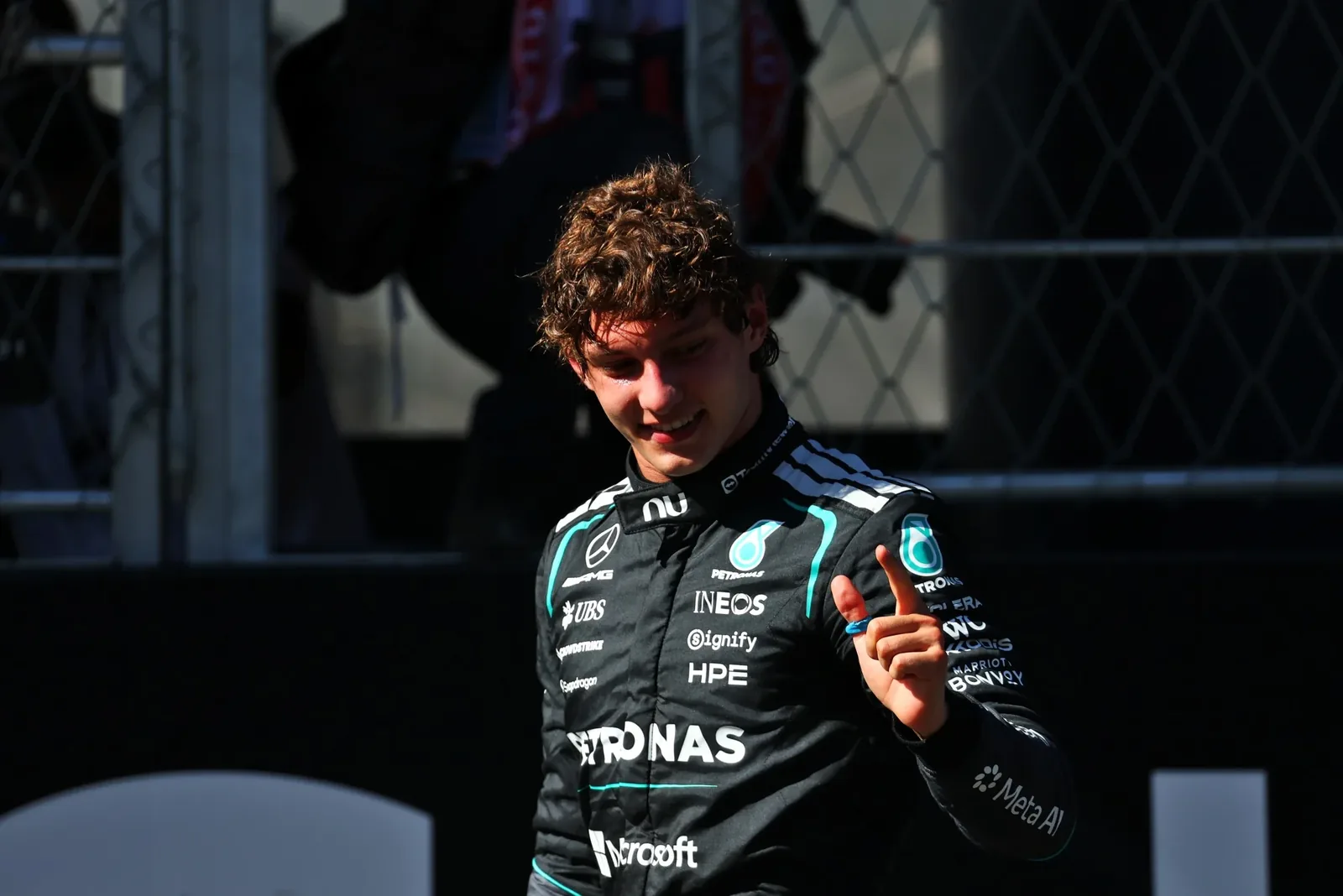
George Russell was the fastest in the first free practice of the Spanish GP, held this Friday (11) at Madring. In the first official session in the history of Formula 1 at the new Madrid circuit, the Mercedes driver set 1:34.077 and led a one-two for the team, with Kimi Antonelli in second, 0.286 seconds behind.

Charles Leclerc finished third and Lewis Hamilton was fourth, after Ferrari showed strength mainly with the medium tires. Max Verstappen was fifth, followed by Lando Norris, Arvid Lindblad, Oscar Piastri, Nico Hülkenberg, and Liam Lawson. Gabriel Bortoleto finished 11th, with 1:35.652, after setting the best first sector of the session in his attempt with soft tires before encountering traffic in the final section.
Free Practice 1
Formula 1 officially opened its history at Madring at 08:30 Brasília time. The new Madrid circuit is 5.414 km long with 22 turns, combining public roads and permanent sections in a layout that mixes street circuit characteristics with those of a conventional racetrack.
Among the major challenges is Turn 12, named La Monumental. It is approximately 550 meters of banked curve, with 24% inclination and about six seconds of continuous load on cars and tires.
The first sector features a high-speed sequence, while the middle part mixes medium and low-speed corners. The layout also offers heavy braking zones and points where cars can reach close to 340 km/h.
More than immediately seeking the best time, drivers and teams needed to use the 60 minutes to discover a completely new track and compare the data obtained in the simulator with reality.
The asphalt was also one of the main unknowns. The new and very smooth surface was expected to initially present a relatively low level of grip and evolve as cars laid down rubber.
Pirelli brought the C2, C3, and C4 compounds, respectively hard, medium, and soft. Simulations placed Madring among the five most demanding circuits of the season in terms of energy transmitted to the tires.
There was also some concern about interruptions. Previous Formula 3 activities and the Formula 2 practice on Friday had shown a track potentially prone to errors and red flags.
Bortoleto starts alone on hard tires
As soon as the green flag appeared, practically the entire field left the pits.
With 22 turns to learn, no one wanted to waste the first minutes.
Almost all drivers started using medium tires. The main exception was Bortoleto, who began Audi’s program on hards. Hülkenberg was the only one who took a little longer to leave the garage.
Ocon quickly brought an interesting first piece of information over the radio: in the Haas driver’s perception, the grip of the new asphalt was high.
Times naturally started far from what would be achieved later.
Verstappen initially took the lead with 1:39.257, but the leaderboard changed practically every lap.
Leclerc lowered it to 1:38.504.
Bortoleto also quickly found his references and set 1:39.042, moving up to fourth even using hard tires.
The gaps were still huge. At one point, Gabriel was fifth but almost three seconds behind the reference. It was a portrait of the learning process: each driver discovered the track and found their limits at different speeds.
Hamilton accelerated the evolution by setting 1:36.066.
Piastri reached 1:37.741, Norris set 1:37.251, and Lindblad appeared with 1:38.395. Lawson also entered the top times with 1:36.833, while Verstappen lowered to 1:36.683.

Ferrari emerges as the first benchmark
Hamilton kept improving and reached 1:35.563.
Leclerc responded with 1:35.668, putting Ferrari in the spotlight during the first sequence of laps.
Bortoleto made a pit stop, returned quickly, and continued working on the hards.
The Brazilian set 1:37.665 and then found a considerable jump. With 1:36.620, Gabriel moved up to sixth.
The performance was especially interesting because Bortoleto was still the only driver using hard tires, while rivals worked with mediums.
Hülkenberg also started to appear. The German registered 1:37.560 but had the lap deleted for exceeding track limits. Shortly after, he set 1:36.613 and moved up to seventh.
Hamilton lowered the benchmark again and set 1:34.803, despite making a mistake on his lap.
Leclerc responded. With 1:34.683, the Monegasque put the other Ferrari in the lead.
Read more Nakamura leads sole free practice for F3 decision in Madrid
Thus, even using medium tires, the Italian team started the session as the main reference at Madring.
Bortoleto, still on hards, reached 1:36.299, while Hülkenberg advanced to 1:36.086.
Mercedes puts on softs and takes control
Shortly before halfway through the session, the first soft tires began to appear.
Antonelli, Russell, and Lawson were among the drivers who switched to C4, and times started to drop.
Hamilton further improved to 1:34.620, a mark that would later be enough to place him fourth in the final result.
Russell began his sequence on softs and first advanced to 1:34.729.
Antonelli also accelerated and reached 1:34.683.
Soon after, Russell set 1:34.145 and took the lead for the first time.
The Ferraris, which had led the table with mediums, also put on soft tires. However, the expected performance jump did not appear.
Hamilton especially could not make great advances with the faster compound, while Leclerc also did not immediately threaten Mercedes.
Russell made better use of the C4 and lowered his time again.
The British driver reached 1:34.077, a time that would not be beaten.

Bortoleto sets best first sector but encounters Stroll
Audi also changed Bortoleto’s program in the second half of the practice.
After doing most of the session on hard tires, the Brazilian finally received the softs.
And his first attempt started very strong. Bortoleto recorded the best first sector of the entire session at that moment.
The lap, however, was compromised in the final section.
Gabriel encountered Stroll on the way and was clearly hindered by traffic. Even so, he completed the lap in 1:35.652, moving up at that moment to ninth position.
The first sector indicated there was potential for a better time if the Brazilian had managed to complete the lap without interference.
Hülkenberg also improved and reached 1:35.529, a mark that would later guarantee him ninth place in the final result.
Antonelli completes Mercedes one-two
Verstappen also found speed in the phase of fast laps and set 1:34.703, while Norris reached 1:34.947 and Lindblad 1:35.033.
Antonelli was the closest to Russell.
The Italian GP winner set 1:34.363 and moved up to second, 0.286 seconds behind his teammate.
With that, Mercedes occupied the top two positions.
In the final part of the session, the focus of several teams began to shift from fast laps to race simulations.
Russell, for example, returned to medium tires to work on a longer sequence. Other drivers also started to evaluate the behavior of the compounds with more fuel, information especially valuable as it was Madring’s debut.
Alpine started the practice quite far back after the strong result obtained in Monza but managed to improve during the final minutes. Gasly reached 1:35.757, while Colapinto set 1:35.933.
Leclerc also managed a last improvement.
The Monegasque set 1:34.536 and moved up to third, confirming Ferrari immediately behind the two Mercedes.
The checkered flag then ended the first 60 official minutes in the history of Formula 1 at Madring.
Russell is the first F1 leader at Madring
Russell finished on top with 1:34.077, leading the Mercedes one-two. Antonelli was second with 1:34.363.
Ferrari placed both its cars immediately behind. Leclerc finished third with 1:34.536, while Hamilton was fourth with 1:34.620. The Italian team’s performance drew attention mainly because their best initial references came still on medium tires, before the softs did not deliver the same jump observed in some rivals.
Verstappen finished fifth, followed by Norris, Lindblad, and Piastri.
Audi placed Hülkenberg ninth, while Lawson completed the top 10.
Bortoleto finished 11th, with 1:35.652, just 0.123 seconds behind Hülkenberg and 0.113 seconds behind Lawson, the last driver inside the top ten.
The result, however, did not tell the whole story of the Brazilian’s session. Bortoleto ran the first part of FP1 on a different program, using hard tires while practically the rest of the field worked with mediums. When he put on the softs, he even recorded the best first sector before encountering Stroll in the final section of his fast lap.
In Formula 1’s first competitive contact with Madrid, therefore, Mercedes set the benchmark, Ferrari showed strength, and Audi appeared close to the top 10 with both its cars**.
FP1 result of the 2026 Spanish GP:
1) George Russell (Mercedes), 1’34.077
2) Kimi Antonelli (Mercedes), 1’34.363
3) Charles Leclerc (Ferrari), 1’34.536
4) Lewis Hamilton (Ferrari), 1’34.620
5) Max Verstappen (Red Bull/Red Bull Ford), 1’34.703
6) Lando Norris (McLaren/Mercedes), 1’34.947
7) Arvid Lindblad (Racing Bulls/Red Bull Ford), 1’35.033
8) Oscar Piastri (McLaren/Mercedes), 1’35.148
9) Nico Hülkenberg (Audi), 1’35.529
10) Liam Lawson (Red Bull/Red Bull Ford), 1’35.539
11) Gabriel Bortoleto (Audi), 1’35.652
12) Esteban Ocon (Haas/Ferrari), 1’35.834
13) Franco Colapinto (Alpine/Mercedes), 1’35.933
14) Pierre Gasly (Alpine/Mercedes), 1’36.244
15) Fernando Alonso (Aston Martin/Honda), 1’36.473
16) Oliver Bearman (Haas/Ferrari), 1’36.853
17) Carlos Sainz (Williams/Mercedes), 1’36.870
18) Yuki Tsunoda (Racing Bulls/Red Bull Ford), 1’36.939
19) Lance Stroll (Aston Martin/Honda), 1’37.254
20) Alexander Albon (Williams/Mercedes), 1’37.591
21) Sergio Pérez (Cadillac/Ferrari), 1’38.150
22) Valtteri Bottas (Cadillac/Ferrari), 1’38.818
Read more F2: Tsolov leads free practice marked by strong accident of Inthraphuvasak