

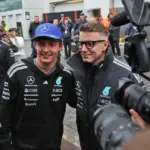


Liam Lawson and Yuki Tsunoda reacted to Max Verstappen’s assessment of the 2026 Formula 1 cars. The four-time world champion stated that the new models reduced the importance of the driver’s performance, making it easier to achieve a high level of performance.
Read more F1: Tsunoda wants a seat in 2027 and does not accept being a reserve driver again
Verstappen used Lawson and Tsunoda’s experiences to support his argument. The New Zealander took over the Red Bull Racing car replacing the injured Isack Hadjar, and the Japanese driver stepped in for Lawson at Racing Bulls while Hadjar is sidelined, with a different car, no prior experience, and managing to be reasonably competitive.

According to Verstappen, characteristics related to energy management have changed the way of driving: “Usually, the driver who is more committed, brakes later, accelerates earlier, and commits in high-speed corners is rewarded. But now you are constantly thinking: ‘In this corner maybe I have to hold back a bit, accelerate later, brake earlier or lift off. And then I have more top speed.’ That is so unnatural,” he told the BBC.
Lawson agreed that there are aspects that may be less directly under the drivers’ control, although he highlighted the complexity of the current cars: “Sometimes I can understand. I feel there are things that might be less under our control with the way energy works,” he said.
Read more F1: Browning reveals important advice he received from Verstappen
At the same time, the Racing Bulls driver considered that his recent experience shows another difficulty. He stated that he has characteristics from his previous car to which he adapted over a year and a half, and that he cannot simply transfer to a different model: “There are things I haven’t been very comfortable with in the last races and that I have been trying to work around,” he added.

Tsunoda took an even more distant stance from the comparison made by Verstappen: “Those are his comments, so… I don’t know. I really just read it, to be honest. That’s it,” said the Japanese driver, who scored a point in Monza.
The Japanese driver acknowledged that energy management is different, and that there are corners where it is not possible to fully accelerate, something he experienced at the Italian GP. Still, he preferred to evaluate his own performance: “I’m not really taking anything from his comments and comparing it with my results. It’s a very individual thing, I think. So, I think I did a good job and that’s it,” he concluded.
Read more F1: Verstappen questions FIA’s assessment of Red Bull Powertrains-Ford engine