









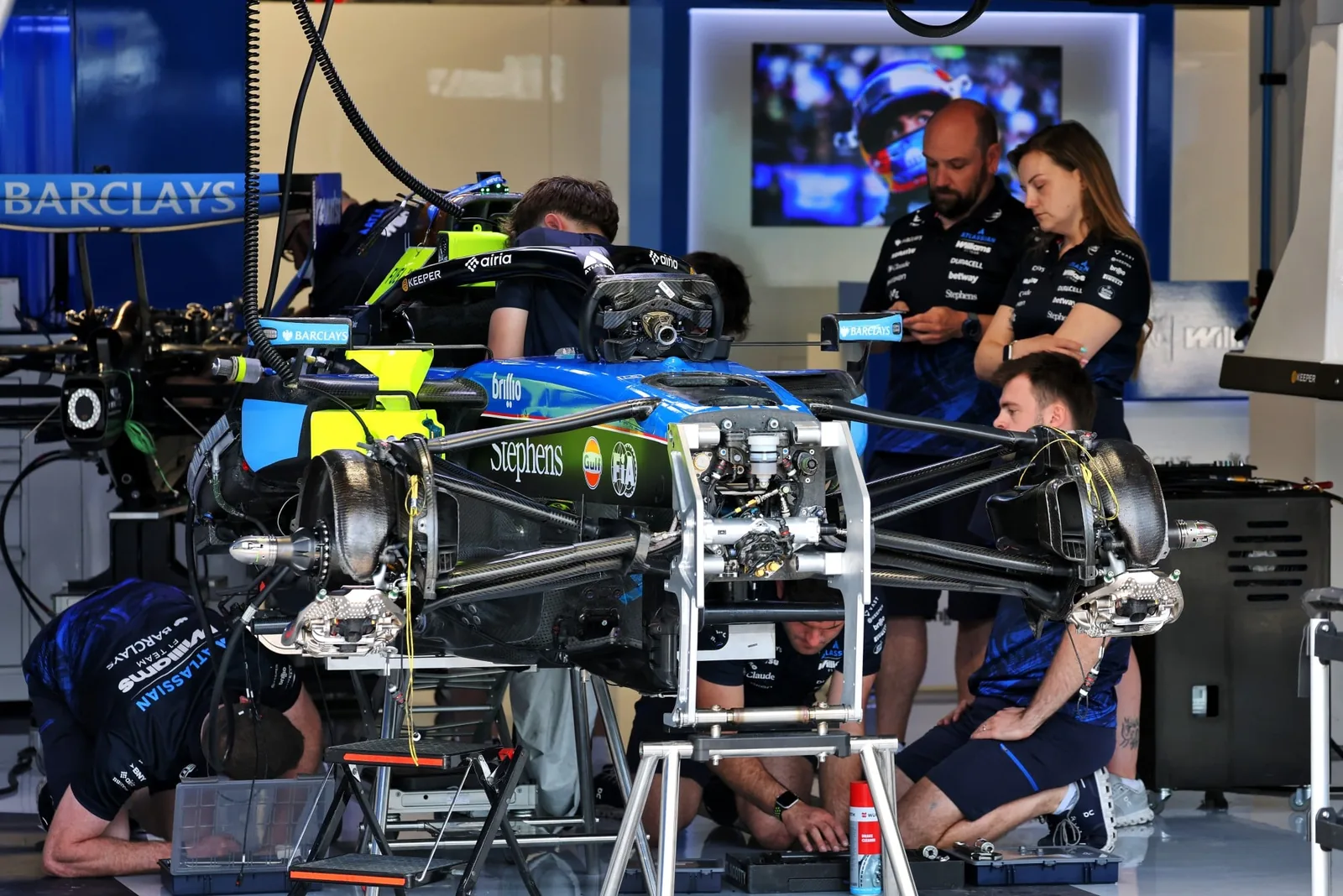
Benefit created by the FIA expands development possibilities for manufacturers who fall behind, but performance recovery is far from immediate.
Read more F1: FIA technical change alters car performance in Monaco
Since the FIA announced the ADUO system for the new generation of Formula 1 engines, a question has been circulating in the paddock and among fans: after all, will the mechanism be enough to quickly put a lagging manufacturer back in the fight? The short answer is no.
Although ADUO offers important tools to accelerate the development of power units, recovering a significant disadvantage in an engine design remains a complex, expensive, and, above all, time-consuming process.
The system was created to prevent a manufacturer from being stuck for years with a clearly inferior power unit, but it does not turn a less competitive engine into a category benchmark overnight.
The very structure of the 2026 engines helps explain this reality.
Unlike an aerodynamic update, which can be designed, produced, and brought to the track in a few weeks, a power unit evolution requires a much longer sequence of technical and validation steps.
The path to an engine upgrade
Before a new part reaches the car, it needs to go through a long development process.
In general terms, the cycle includes:
– Problem identification
– Development of the new concept
– Computational simulations
– Part design
– Manufacturing of the first prototypes
– Bench testing
– Reliability testing
– Homologation with the FIA
– Mass production
– Distribution to customer teams
Each of these steps consumes time, human resources, and budget.
In many cases, just accurately identifying the source of a performance loss can take weeks of analysis of data collected on track and on test benches.
What does ADUO really offer?
The benefit granted by the FIA acts precisely on some of the main obstacles in this process.
Manufacturers enrolled in the program receive more freedom to update power unit components, as well as relaxations related to the budget allocated to engines and the time available for bench testing.
In practice, this allows a manufacturer to accelerate the development of solutions for problems identified in the original design.
But there is an important difference between being able to develop and being able to quickly implement a solution.
Even with extra resources, a manufacturer still needs to design, manufacture, test, and homologate any new part before putting it on the track.

The extreme example: when the delay is large
During discussions about the regulations, experts used hypothetical scenarios involving manufacturers who might start the 2026 era far behind the competition.
Read more F1 2026: what remains frozen even with the ADUO?
Even in more critical situations, ADUO was not designed to allow a complete overhaul of the power unit in a few months.
The regulations may open additional development areas and offer extra resources to speed up recovery, but the basic engine architecture remains. In many cases, fundamental design limitations cannot be corrected immediately.
Therefore, a manufacturer starting the season with a large deficiency will likely need more than one homologation and multiple update cycles to reduce the gap to the leaders.
The obligation to customer teams
Another factor influencing the schedule is the need to provide any update to all customer teams at the same time.
This means the manufacturer not only needs to develop a new solution. They also must produce enough units to supply all teams using that engine.
Depending on the complexity of the update, this can add weeks or even months to the process.
Additionally, some teams may need to adapt chassis components, cooling systems, or internal car installations to accommodate certain power unit evolutions.
So does ADUO work?
The most appropriate answer is that the system increases the chances of recovery but does not eliminate the inherent difficulties of developing Formula 1 engines.
The FIA created the mechanism to prevent a manufacturer from being condemned to several years of disadvantage without the possibility of reaction. At the same time, the entity sought to preserve the technical merit of those who get the design right from the start.
Therefore, ADUO works more as a development accelerator than as a magic solution.
If a manufacturer is a few steps behind rivals, the system can help reduce the gap more quickly. But if the disadvantage is deep, recovery will still require months of work, multiple updates, and enormous technical effort.
In other words, ADUO can shorten the path to competitiveness but does not eliminate the “walk.”
Read more F1: Mercedes gives up investing in Alpine after deadlock