









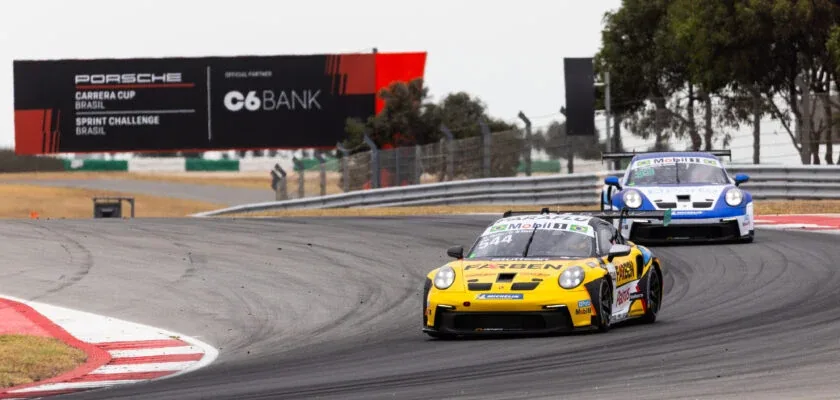
After the three-stage European tour in June and July, in which the Porsche Cup Brasil made history by holding a race as a preliminary event to the 24 Hours of Le Mans in France, and a double round with sprint and endurance at the Portimão circuit in the Algarve, Portugal, the category returns to Brazilian soil for the sixth stage of the season, and on a no less iconic stage: the Interlagos Autodrome in São Paulo. The reunion with the São Paulo track takes place after the end of the long hiatus that began at the last race, held on July 12, on European soil.
Read more F1: Norris admits that «there were opportunities» to leave McLaren before renewing contract
The weekend event marks a historic milestone in the championship’s trajectory: a total of 81 drivers will be on the starting grids, setting an absolute record for participants in a sprint stage of the event. The impressive contingent of the most produced racing model on the planet is divided among the Carrera Cup divisions (38 entrants), Sprint Challenge (22), and Trophy (21).

To ensure the safety and precision of the braking of this huge peloton, Fremax is the official supplier of brake discs for Porsche Cup Brasil, an alliance maintained uninterruptedly since 2007. The vehicles feature the brand’s slotted disc technology. This exclusive design has grooves on the surface that quickly expel dust, debris, and heated gases, keeping the friction zone with the pad unobstructed. The solution ensures linear and constant performance even under severe use, guaranteeing even greater structural rigidity and crack prevention compared to drilled options.
Additionally, the line features the Carbon+ metal alloy, enriched with a high carbon content. Its graphite-based microstructure optimizes heat dissipation and accelerates the cooling of parts between decelerations. This directly combats oxidation, prevents thermal deformation, reduces pedal fatigue, and increases the lifespan of components throughout the race.
The extreme demand on the braking system can be translated into numbers right at the most critical point of the São Paulo track: the famous Senna S. On board the Porsche 911 GT3 models of the 992 generation, drivers approach at speeds close to 260 km/h and need to reduce to about 82 km/h within just 190 meters. Along this specific section, the pressure exerted on the pedal reaches an average of 188 kg/cm², generating a deceleration of 2.16 G over 4.2 uninterrupted seconds with the brakes applied.
Read more F1: Perez confirms plan to create team and help young drivers
For the weekend, the weather adds an extra layer of strategic complexity. The forecast indicates rain for Saturday and Sunday, accompanied by a sharp drop in temperature throughout the schedule. The maximum expected for Friday is 27 degrees, but the thermometers should plunge to just 15 degrees on Sunday.
“Interlagos is always a comprehensive test for our components, and the conditions forecast for this weekend will demand even more flexibility from the system. The large temperature variation, going from milder weather on Friday to intense cold and wet track on Sunday, drastically changes the heating and heat dissipation dynamics of the discs,” analyzes Jaison Picoli, Engineering Coordinator at Fremax.
“The Carbon+ technology and the slotted design of Fremax discs ensure that the braking response remains stable and predictable for the driver, regardless of whether we are dealing with the heat generated by the strong decelerations of the Senna S or the abrupt cooling caused by water on the track. This ability to maintain performance under severe fluctuations is exactly what we test in a competitive environment before transferring it to the aftermarket,” continues the engineer.
All the experience gained over more than two decades working on race tracks serves as a real-time innovation laboratory for Fremax, allowing engineering validation that is later applied to street parts intended for workshops and consumers.
Read more F1: Stella points out Norris’ change in attitude after winning streak