


There is a paradox hidden in Red Bull’s 12 points in four races of 2026. Red Bull Powertrains, in its first year of independent operation, produced — according to technical analyses circulating in the paddock — the second-best power unit on the grid. About 565 hp against the estimated 576 hp of Mercedes, a deficit of 1.9%. Ferrari is at ~547 hp, Audi at ~545, Honda (Aston Martin) at ~519. The RB22 unit beats Ferrari, beats Audi, humiliates Honda. And the team is fourth in the constructors’ championship, behind McLaren. For those who follow Formula 1 also from the perspective of probabilities, this kind of contrast shows why consulting a ranking of betting houses for the Brazilian bettor can be useful before interpreting odds, performance markets, and favorites by circuit.
Read more F1: Steiner sees Bearman ready to replace Hamilton
This is the starting point to understand what happened in Milton Keynes.
The engine is not the problem (but it has its own problem)
Laurent Mekies publicly admitted a “three-tenths” deficit to Mercedes, attributing most of it to the ICE. The cruelest data, however, is structural: with a 1.9% gap, RBPT is outside the first tier of the ADUO — the 2026 catch-up mechanism that releases extra development tokens for manufacturers more than 2% behind the benchmark. Ferrari, Audi, and Honda are expected to receive additional upgrades. Red Bull will not. Perfect irony: the unit is good enough to deny regulatory help, but insufficient to compete for the title.
Reliability paid the expected price of a new project — Hadjar’s retirement in Melbourne, liquid leak in Verstappen in China — but it is noise over the structural signal. The Racing Bulls, with the same PU, posted the second and third best times in Sector 2 of Australia, dominated by power. The engine delivers. The chassis does not translate it.
Weight: execution error, not concept error
The FIA cut the minimum limit from 798 kg to 768 kg in 2026, and Pierre Wache admitted since Bahrain that the RB22 started ~12 kg above. The Miami package brought this number down to ~6 kg, with a goal to reach the minimum by the Austrian GP. By the practical rule of three hundredths per kg, that is 18 to 36 hundredths per lap purely parasitic — even before touching aerodynamics.
This is painful, but it is the kind of problem that is solved with wind tunnel time and development schedule. It is not existential.
Drag: the fundamental error
Here lies the real collapse. The RB22 design philosophy prioritized low drag at the expense of downforce — a defensible bet in theory, given that the new aerodynamic regulation requires about a 40% reduction in base drag to accommodate the 50/50 split of electric power without the cars dying on the straights. Wache decided that the way was to aggressively attack this axis.
Telemetry data from Shanghai exposed the problem: in turns 7 and 8, a critical energy regeneration zone, Verstappen lost massive time to Antonelli, while matching top speeds in sectors T13-T14. The car flies in a straight line and dies when it needs to load the wheel. Worse: against a Haas — which clearly loses on the straights — Red Bull could not overtake because the deficit in the corners canceled any advantage in X-mode.
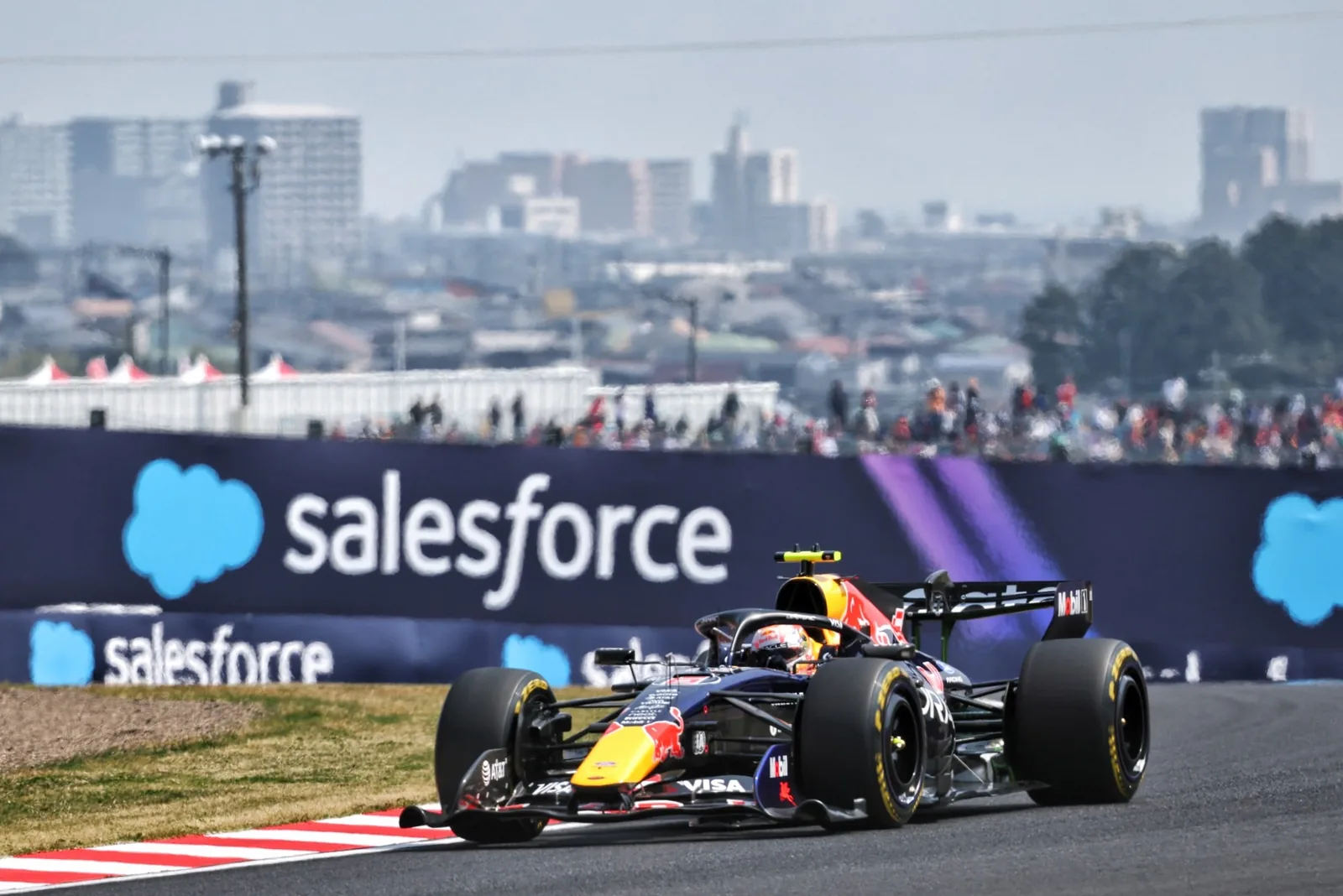
The Suzuka and Miami packages represent a conceptual retreat. Sidepods rewritten abandoning the inwash, Ferrari-type opening, the “Macarena wing” rotating 160 degrees in the opposite direction of the Italian one. In Miami, Verstappen fought for pole. It is a real correction, but it is exactly that: a correction. It is not the original concept working. The realistic window to compete for the title is 2027 — after a full season learning the regulation.
Read more MotoGP: Viñales scores after comeback and drama in Catalonia
The Verstappen tension
When Max calls this generation “Formula E on steroids” and “playing Mario Kart,” both readings coexist.
The legitimate reading: the super-clipping is genuinely weird. Drivers controlling battery deployment like Mario Kart items is a design decision that distances F1 from its mechanical identity. Norris, Alonso, Sainz — drivers in different teams — partly agree. It is not just Red Bull’s tantrum.
The political reading: Verstappen has an active exit clause if he finishes outside the top 2 in the summer break. The decision window is from August to October. Mercedes is available in 2027. Every public press conference undermining the regulation is simultaneously pressure for changes that would benefit Red Bull and narrative building for a cost-free reputational exit. “It’s not the car, it’s the sport” is a technically convenient phrase when your car is fourth.
He himself, in Suzuka, admitted that the problem is “a little engine, but not mainly — it’s grip and balance.” Translation: chassis. Mercedes proved, with the same regulation, that it is possible to make an extraordinary car. The regulation is not inherently bad. It is inherently different — and Red Bull erred in the interpretation.
The two truths do not cancel each other out. Max may be saying true things about the F1 product and using these truths as an instrument. He is a sophisticated enough driver for that. For now, what we know for sure is that the bottleneck is in Milton Keynes — not in Geneva.
F1 2026 Betting Tips: How to Read Red Bull’s Crisis Before Betting
For those looking for F1 betting tips in 2026, the Red Bull case requires caution: the team’s problem does not seem to be only the engine, but especially the aerodynamic balance, weight, and the RB22’s difficulty in generating downforce in corners. This means that betting on Verstappen or Red Bull just by name can be risky, especially on tight circuits, with long corners or high grip demand, where Mercedes and McLaren may have a more consistent advantage.
On low downforce tracks, with long straights and many X-mode opportunities, Red Bull can still be competitive, especially if upgrades continue reducing weight and correcting drag. A good strategy is to analyze sector by sector in free practice: if Verstappen is strong only on the straights but losing a lot in medium and fast corners, markets like pole position, win, or Red Bull one-two lose value. Bets on podium, top 6, direct driver confrontations, and performance by circuit may offer more realistic opportunities, especially while the team is still trying to understand the new regulation.
Read more MotoGP: Bagnaia overcomes chaos and secures podium in Catalonia