




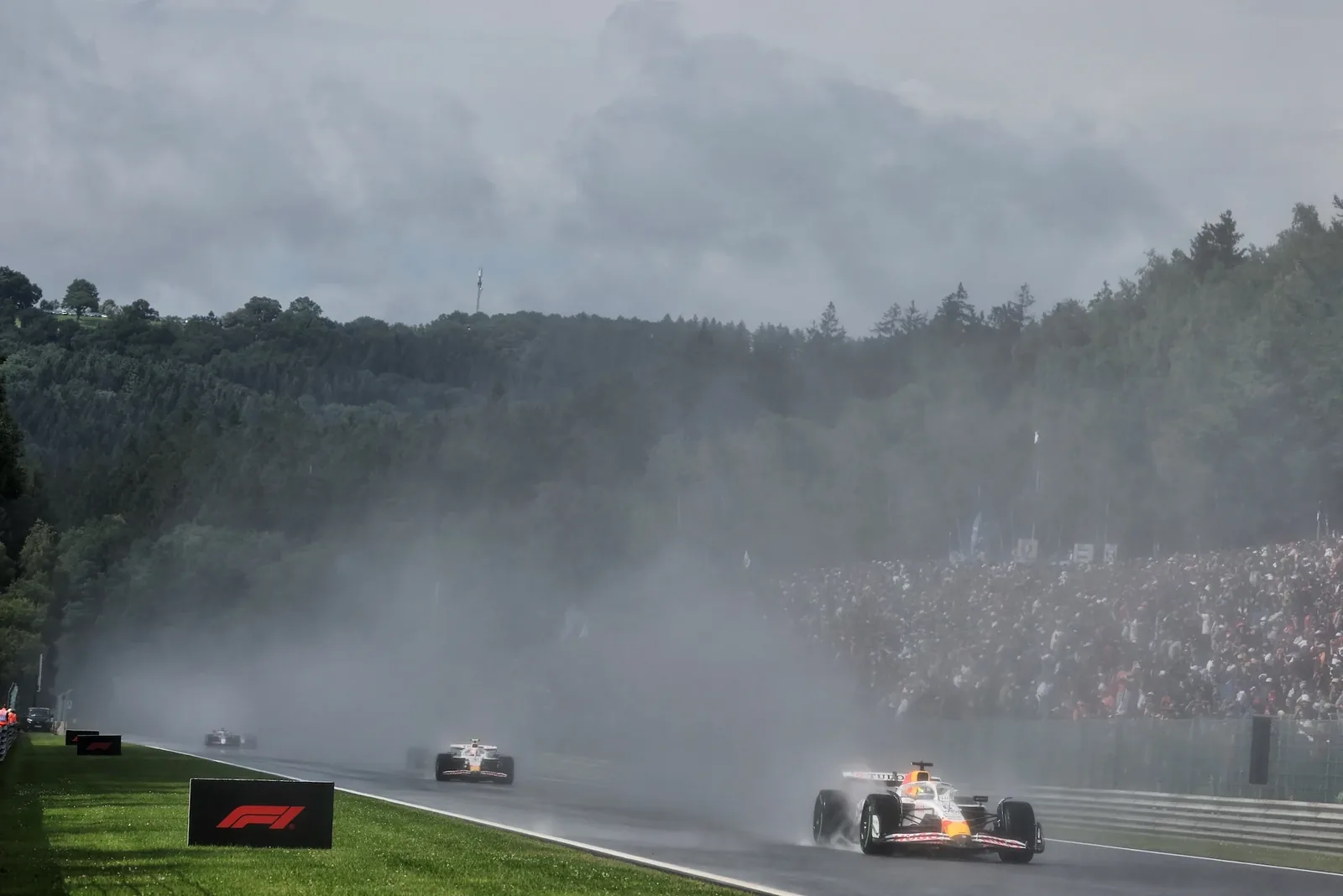
Few Formula 1 circuits experience weather as unpredictable as Spa-Francorchamps. In the Belgian Ardennes, it is common for one sector to be completely dry while another receives heavy rain, creating races where strategy, track reading, and decisions made in seconds can be worth more than the car’s speed.
Read more F1 today: Bortoleto aims at Spa and FIA releases wing
There is an old saying in the Formula 1 paddock that sums up the weekend at Spa-Francorchamps well: if you don’t like the weather, wait five minutes. The phrase may seem exaggerated, but it accurately describes one of the main characteristics of the Belgian circuit.

Unlike most tracks on the calendar, where weather conditions tend to be relatively uniform, Spa challenges drivers and engineers with a rare phenomenon: the circuit is large enough to present completely different weather conditions along its more than seven kilometers of length.
It is not uncommon for the first sector to be completely dry, while the second receives moderate rain and the third presents only a damp track. At other times, the situation reverses within minutes, forcing teams to revise strategies almost in real time.
It is precisely this unpredictability that makes the weather one of the protagonists of the Belgian GP.
A circuit large enough to create its own weather
Spa-Francorchamps is the largest circuit on the Formula 1 calendar.
With more than seven kilometers in length and located in a mountainous region surrounded by forests, the layout crosses areas where temperature, wind, and humidity vary easily. The Ardennes terrain favors the rapid formation of clouds and small rain cells, creating situations rarely seen in other championship rounds.
For the teams, this represents a huge challenge.
Weather radars help predict the approach of rain, but they do not always accurately indicate which part of the track will be affected first or how long the precipitation will last. Often, the decision to change tires must be made by observing only the drivers’ behavior and lap times.
It is a scenario where the experience of strategists weighs as much as the car’s performance.
Tire choice becomes a game of risk
In practically every Formula 1 race, there is a moment when strategy becomes important.
At Spa, this moment can arise as early as the first lap.
When only part of the circuit is wet, tire choice ceases to be an obvious decision. Staying on slick tires can mean gaining a lot of time on dry sections, but it also increases the risk of completely losing control of the car in wet areas. Changing early to intermediate tires offers more safety but can represent a significant loss if the rain is brief.
There is no right answer.
There is only the decision that, at that moment, seems to offer the best balance between risk and reward.
Throughout history, some of the most memorable races at Spa have arisen precisely from these choices.
The driver makes an even bigger difference
When the track presents mixed conditions, the driver’s work becomes even more important.
Instead of repeating exactly the same line every lap, it is necessary to constantly adapt braking points, change the way certain corners are attacked, and identify where grip is still available. Often, one side of the track offers much more grip than the other simply because it received less rain. This reading must happen in real time.
Read more F1: Ricciardo leads vote for best Verstappen teammate
While engineers monitor data and radar images, the person who really feels the car’s behavior is the driver. Communication between the cockpit and pit wall becomes decisive for the team to understand how conditions are evolving. On a circuit like Spa, information is also performance.
The race can change in a few minutes
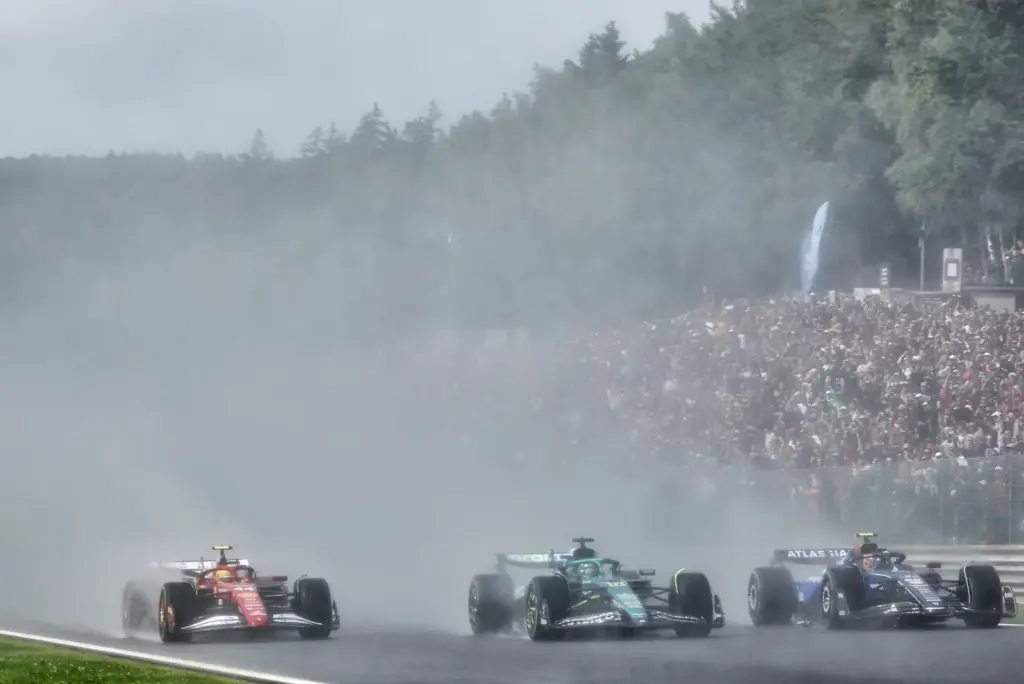
Another aspect that makes Belgium so unpredictable is the speed with which conditions evolve.
A completely wet track can start to dry quickly if the wind changes direction or the sun appears between the clouds. Likewise, a dry section can turn into a trap after localized rain.
These changes completely alter tire behavior.
Intermediate compounds can overheat in a few minutes if the track dries quickly. Slicks, on the other hand, become practically unusable when they encounter large areas of standing water.
It is precisely for this reason that Spa often produces races where strategy remains open until the final laps.
Having the fastest car is not enough
The recent history of Formula 1 shows that good performances at Spa rarely depend solely on speed.
Teams with competitive cars have lost important races by taking an extra lap to change tires. Others have achieved unlikely victories precisely because they better interpreted the weather’s evolution.
In a balanced championship like 2026, this characteristic can become even more significant.
Mercedes, Ferrari, Red Bull, and McLaren arrive in Belgium very close in performance. Under these circumstances, a strategic decision made a few seconds before rivals can represent the difference between fighting for victory or finishing off the podium.
Much more than rain
When talking about Spa, it is common to immediately associate the circuit with the possibility of rain.
But perhaps the real challenge is not the water itself.
What makes the Belgian GP so special is uncertainty. Teams never know exactly how the track will be ten minutes later. Drivers need to trust information that changes constantly. Strategists live with the possibility that any forecast will be invalidated by the next cloud crossing the Ardennes.
It is a scenario that demands speed, adaptability, and courage to make decisions without guarantees.
Perhaps that is precisely why so many historic races have been written at Spa.
Read more F3: Pedro Clerot sees progress in the championship at Spa, where he won for the first time in Europe
Because, in Belgium, rain is rarely just a detail of the race.
Often, it is the race itself.