




The first half of the season changed the order of strength on the grid, placed Mercedes as the benchmark, and showed that the new regulations increased technical variables without necessarily equalizing the teams.
Read more F1 today: Red Bull seeks reinforcement and Leclerc opens door to Verstappen
Eleven Grand Prix races already allow us to separate some initial impressions of more consistent trends in the 2026 Formula 1. The championship began surrounded by doubts about the new power units, the greater weight of electrification, active aerodynamics, and the behavior of cars designed under regulations completely different from those used until the end of 2025. Now, with the category on summer break, some of these questions are beginning to have answers.

The first of these is probably the most important: the regulation change really altered the hierarchy. McLaren, the 2025 constructors’ champion with 833 points and owner of the top two drivers that year, ceased to be the benchmark. Mercedes, second in last year’s championship, took control of the new era. Ferrari and Red Bull also swapped positions in the order of strength, while Sauber’s transformation into Audi added a new factory project to the midfield pack.
But a grid reshuffle does not necessarily mean a more balanced grid. This is perhaps the main conclusion from the first 11 rounds.
Mercedes got the regulations right and opened a lead that the numbers make clear
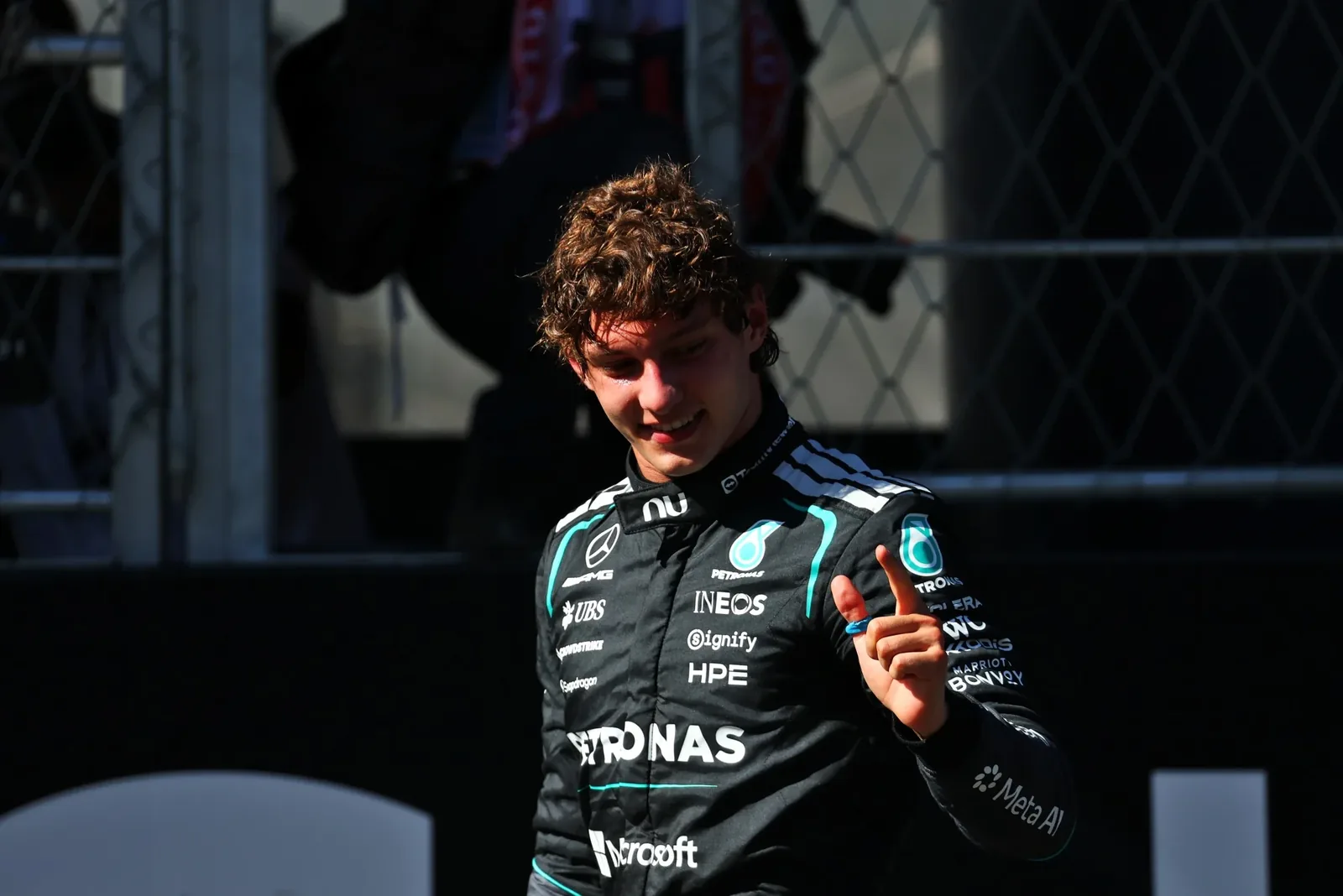
No team interpreted the start of the 2026 regulations better than Mercedes. Of the 11 races held up to the Hungarian GP, eight ended with a W17 in first place. Kimi Antonelli won six times, while George Russell won in Australia and Austria. Ferrari took Barcelona through Lewis Hamilton, and Silverstone with Charles Leclerc, while Lando Norris gave McLaren its first win of the year in Hungary. There are five different winners, but only three winning teams.
Mercedes’ superiority is even clearer on Saturdays. The team secured ten of the 11 pole positions contested. The only exception came precisely in the last round before the break, when Norris put McLaren on pole in Hungary. Besides the eight wins, Mercedes has 14 podiums and leads the Constructors’ Championship with 379 points.
The gap to rivals helps to size this advantage. Ferrari is second with 307 points, 72 behind. McLaren has 220 and Red Bull, 177. Together, the top four teams concentrate just over 86% of all points distributed in the constructors’ championship up to Hungary. They also occupied 32 of the 33 available podium positions in the 11 GPs — the only exception was Pierre Gasly, third in Monaco for Alpine.
Therefore, if one of the goals of the new generation was to increase competition among teams, there is still not enough evidence to say that this has happened across the entire grid. So far, 2026 has mainly produced a new dominant team, not the disappearance of result concentration.
However, this does not mean the scenario is similar to what was seen at the start of previous cycles. The main difference lies in the number of variables involved and, above all, in how each car responds to different circuits and conditions.
Ferrari is the best example. The team has not yet secured a pole position but has already won two races and has nine podiums. Hamilton is second in the Drivers’ Championship with 169 points, while Leclerc is fourth with 138. The SF-26 has not shown the same excellence as Mercedes in qualifying, but has already proven capable of fighting for wins when race pace, tires, and strategy come into play.
McLaren is in a different situation. After dominating 2025, it started the new cycle behind Mercedes and Ferrari and still faced difficulties extracting the full potential of the new Mercedes power unit. In China, for example, the team had electrical problems that prevented both cars from starting the GP, and Norris also suffered setbacks related to the power unit in other rounds. In Spa, the British driver had to use new components and received a grid penalty.
Even so, the reaction exists. McLaren made a one-two on the podium in Miami, appeared again among the strongest teams in Barcelona and Silverstone, and finally turned this evolution into a win in Hungary. Norris has 128 points and is fifth in the championship, while Oscar Piastri is just behind Verstappen with 92. The team has 220 points, five podiums, one pole, and one win.
Red Bull perhaps represents the biggest break from what has become usual in recent years. The team that dominated a significant part of the previous cycle arrived at the break without a win or pole position in 2026. Verstappen still managed to put the car on the podium four times and has 109 points, but not even his ability to extract performance has been able to regularly put Red Bull back in the fight for first place. The team is only fourth among the constructors.

The cars changed and so did the way to extract time from them
The change in behavior is not surprising given the scale of the regulations. The 2026 generation was designed with smaller and lighter cars, significant reduction in drag and aerodynamic downforce, movable front and rear wings, and a power unit in which the electric contribution increased drastically. The MGU-K power rose from 120 kW to 350 kW, while energy recovery gained much greater importance.
In practice, this added new layers to driving. Energy management now has an even more direct impact on how to attack and defend, while tools like Active Aero, Boost Mode, and Overtake Mode have become part of the drivers’ routine. It is not enough to find mechanical and aerodynamic grip: it is also necessary to place the car at the right point of its energy window throughout the lap and race.
This factor also helps explain why different circuits produced different strength relationships. McLaren showed strength in Miami and finally won in Hungary. Ferrari managed to turn its pace into wins in Barcelona and Silverstone. Verstappen took Red Bull to second place in Austria and again in Hungary, even though the RB22 did not show the ability to control an entire weekend. Spa, in turn, allowed Audi to put Gabriel Bortoleto in Q3 and finish as the best team outside the top four group.
Read more TCR: Next Gen Drivers will have a weekend with special stages
This suggests that sensitivity to each track’s characteristics remains high. Mercedes has the most complete package, but rivals can get closer when certain elements — aerodynamic efficiency, behavior in slow or fast corners, tire management, and energy use — favor their solutions.
Reliability itself is still an important variable. Having the most competitive power unit did not make Mercedes immune to problems. Russell retired from the Canadian GP while leading due to a power unit failure, while Antonelli lost a possible podium in Barcelona due to a mechanical problem. McLaren also suffered with the Mercedes package at different moments in the first half. In other words: the new generation has already shown a high level of performance but has not yet reached the technical maturity of the regulations ended in 2025.
Audi and Bortoleto show how the new order is still being built
Further back, Audi’s season may be one of the most interesting demonstrations of how a regulation change can open space for evolution.
The German team officially entered Formula 1 in 2026 by taking over the old Sauber structure and, unlike the main competitors, uses its own power unit without relying on customer teams to expand data collection. After 11 rounds, it is only eighth among constructors with 12 points, but the championship snapshot hides a significant evolution curve.
Bortoleto scored two points right in Audi’s debut, with ninth place in Australia. Then came months of results close to the points zone, including three consecutive 11th places in Monaco, Barcelona, and Austria. The reward came in Silverstone and Spa, when the Brazilian finished eighth twice in a row. Of the 12 points Audi earned up to the break, ten belong to Bortoleto.
Spa was particularly revealing. Even on a circuit where the recognized deficiency of the Audi power unit could represent a significant disadvantage, Bortoleto reached Q3, started among the top ten, and finished eighth, ahead of the rest of the midfield pack. The result showed that chassis and aerodynamics can already compensate, under certain conditions, for some of the limitations in other areas of the project.
It is also a demonstration of the weight drivers have gained in this early phase of the regulations. Antonelli turned the best car on the grid into six wins and the championship lead, Hamilton adapted to the new generation and won again, Verstappen continues producing podiums even without a dominant Red Bull, and Bortoleto managed to convert Audi’s evolution into results precisely when the car began to offer that possibility.
This does not mean that driver talent has become more important than engineering — in Formula 1 this hardly ever happens. It means that, while teams are still learning to use completely new systems, the ability to quickly understand the equipment’s limits and manage energy, tires, and aerodynamic behavior can further separate two drivers with the same car.
After 11 races, therefore, the new Formula 1 has already answered some questions and left others open.
We know that Mercedes started the cycle in front. We know that McLaren lost the benchmark position it held in 2025. We know that Ferrari has a car capable of winning again and that Red Bull is no longer an automatic presence in the fight for first place. We also know that new projects, like Audi’s, can find performance during the season itself.
What we still do not know is how much of this snapshot will survive development.
The FIA has already used the first 2026 events to evaluate and adjust aspects of the new regulations, including issues related to energy management. At the same time, teams and manufacturers continue accumulating knowledge about cars and power units that have only a few months of competition.
There are 12 rounds left. Monza will again put efficiency and power under enormous pressure; Baku will add long straights and low downforce; Singapore will demand performance at low speed; and other circuits will still offer completely different tests.
Therefore, perhaps the main conclusion from the first 11 races is also the most provisional: the 2026 regulations have already changed who rules Formula 1, but have not yet proven they can permanently reduce the gap between those who lead and those who chase.
The first half was enough to discover a new hierarchy. The second will be responsible for saying if it is here to stay.
Read more F1: Montoya rules out Hamilton retirement after reaction at Ferrari