






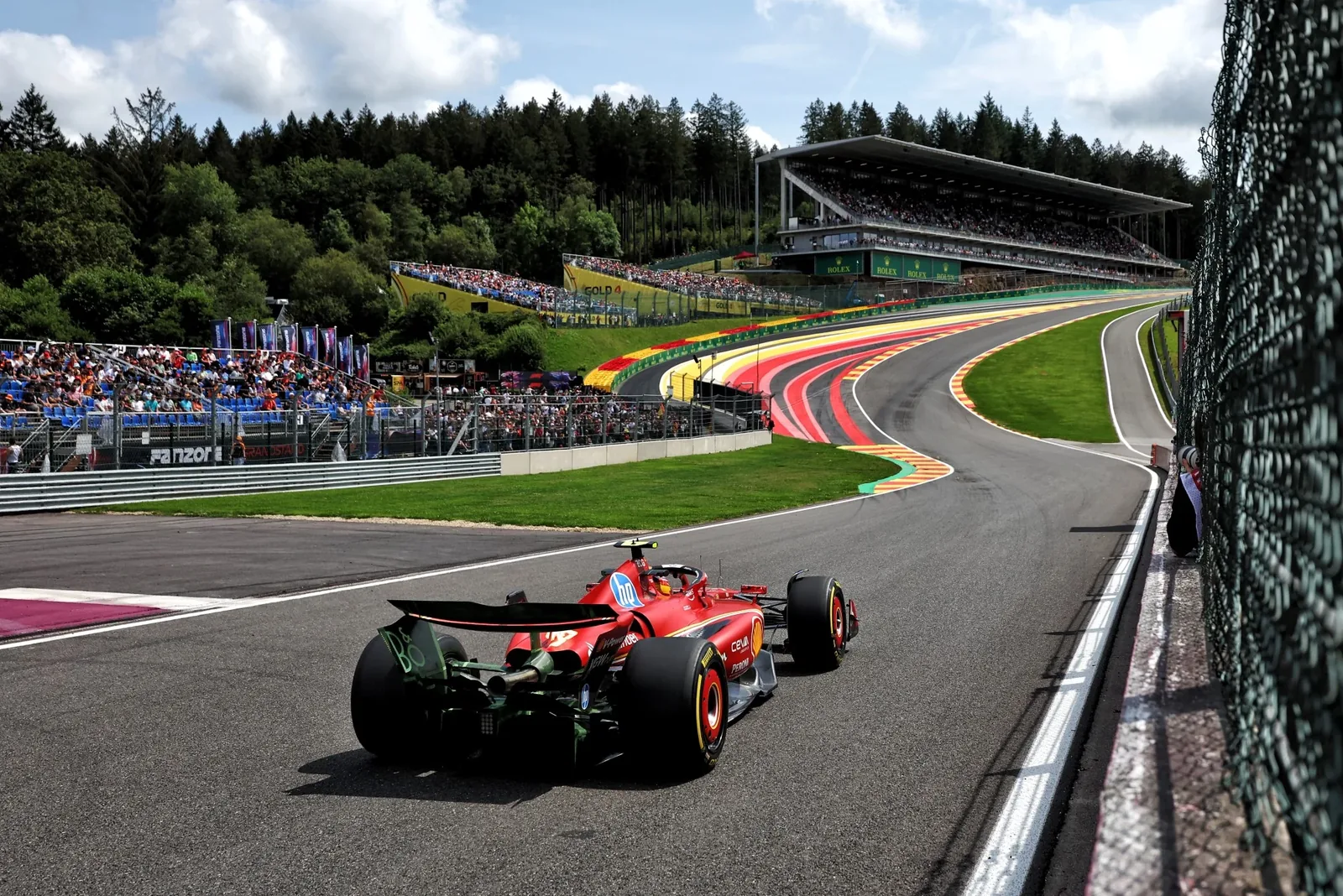
Few circuits challenge a driver as much as Spa-Francorchamps. With more than seven kilometers in length, elevation changes, high-speed corners, and completely different sections, the Belgian layout turns every fast lap into an exercise in precision, confidence, and commitment.
Read more F1 today: FIA changes Spa and Hamilton demands Ferrari
Every Formula 1 driver dreams of the perfect lap. It is that lap where every braking point happens at the exact moment, every curb is used correctly, and every corner seems to naturally connect to the next. In a sport where thousandths of a second make a difference, finding this combination represents one of the greatest challenges in the category.

At Spa-Francorchamps, however, this mission takes on another dimension.
More than building a fast lap, the driver needs to survive a circuit that demands practically all possible skills within a Formula 1 car. It is just over seven kilometers where confidence, technique, sensitivity, and courage walk side by side. Perhaps that is why so many drivers consider a pole position at Spa one of the greatest demonstrations of talent of the season.
The question is inevitable: is there a lap more difficult than this in Formula 1?
A track that offers no rest
The first reason lies in the circuit’s own length.
While on much of the calendar a lap lasts just over a minute and a half, Spa demands almost two minutes of absolute concentration. It may seem like a small difference, but it completely changes the dynamics of qualifying.
The longer the lap, the greater the number of decisions that need to be made correctly.
A small mistake made in the first kilometers follows the driver all the way to the finish line. Unlike shorter tracks, where there is still room to recover some lost time, at Spa every mistake compromises the entire lap construction.
This makes the margin for perfection extremely small.
Each sector demands a different driving style
Another factor that makes Spa unique is the variety of challenges presented throughout the lap.
The first sector favors straight-line speed and heavy braking. Right after, Eau Rouge and Raidillon demand total commitment from the driver before the long acceleration down the Kemmel straight.
In the second sector, the scenario changes completely.
Corners like Bruxelles, Pouhon, and Fagnes require car balance and extreme precision in choosing the racing lines. Here, more than courage, the driver needs to show sensitivity to understand exactly where the grip limit is.
In the third sector, fast corners, direction changes, and constant accelerations come into play until the main straight.
In practice, Spa combines in a single lap characteristics that, on other circuits, appear separately.
It is like competing in three different qualifying sessions in just one lap.
Confidence is as valuable as talent
There is one characteristic that sets Spa apart from most modern tracks.
The driver often needs to accelerate even before fully seeing the corner exit.
This happens because several elevation changes hide parts of the layout, forcing those in the cockpit to fully trust the car’s behavior. In high-speed corners, any hesitation means immediate loss of time.
At the same time, overconfidence can also be punished.
Finding this balance may be the greatest difficulty of the lap at Spa. The driver needs to attack each corner knowing exactly how far they can go, without exceeding a limit that often changes according to track temperature, wind, or tire wear.
Few laps demand such psychological commitment.
The weather makes everything even more complex
As if the circuit were not challenging enough, Spa adds another element capable of completely transforming a qualifying session.
Read more Enzo Gianfratti rises five positions in the TCR World Championship
The weather.
The Ardennes are known for rapid changes in weather conditions, and this means that the same lap can start on a dry track and end on a wet section. Even when it does not rain, changes in temperature and wind intensity significantly modify the grip level throughout the session.
This prevents drivers from using exactly the same references from one attempt to another.
Each lap becomes unique.
And precisely because of this, finding the perfect lap depends not only on the driver’s talent but also on their ability to adapt.
The car also needs to be perfect
At Spa, a great lap never depends solely on the driver.
Engineers need to deliver a car capable of performing in three completely different sectors. Low aerodynamic downforce improves speed on the straights but makes fast corners harder. High downforce does the opposite.
Finding this compromise is one of the toughest tasks of the championship.
When driver and car finally sync, Spa rewards this work like few circuits can.
That is why so many historic poles won in Belgium are remembered for years.
Not just for the recorded time, but for the complexity of the task.
More than just a lap time
It may be impossible to categorically state that Spa offers the most difficult lap in Formula 1.
Suzuka, Silverstone, and Monaco also present unique challenges. Each demands different qualities from drivers and tests specific skills.
But few manage to bring together as many elements in a single attempt as the Belgian circuit.
A great lap at Spa demands speed, precision, confidence, adaptation, reading track conditions, understanding the car, and the ability to maintain absolute concentration for almost two minutes.
It is a complete test.
Perhaps that is exactly why so many world champions describe the feeling of nailing a perfect lap at Spa as one of the greatest satisfactions a driver can experience.
Because when everything finally clicks, it is not just the stopwatch that confirms the result.
The driver themselves knows they have just conquered one of the greatest challenges Formula 1 still has to offer.
Read more Reis leads TCR Brazil by three points before the championship decision