

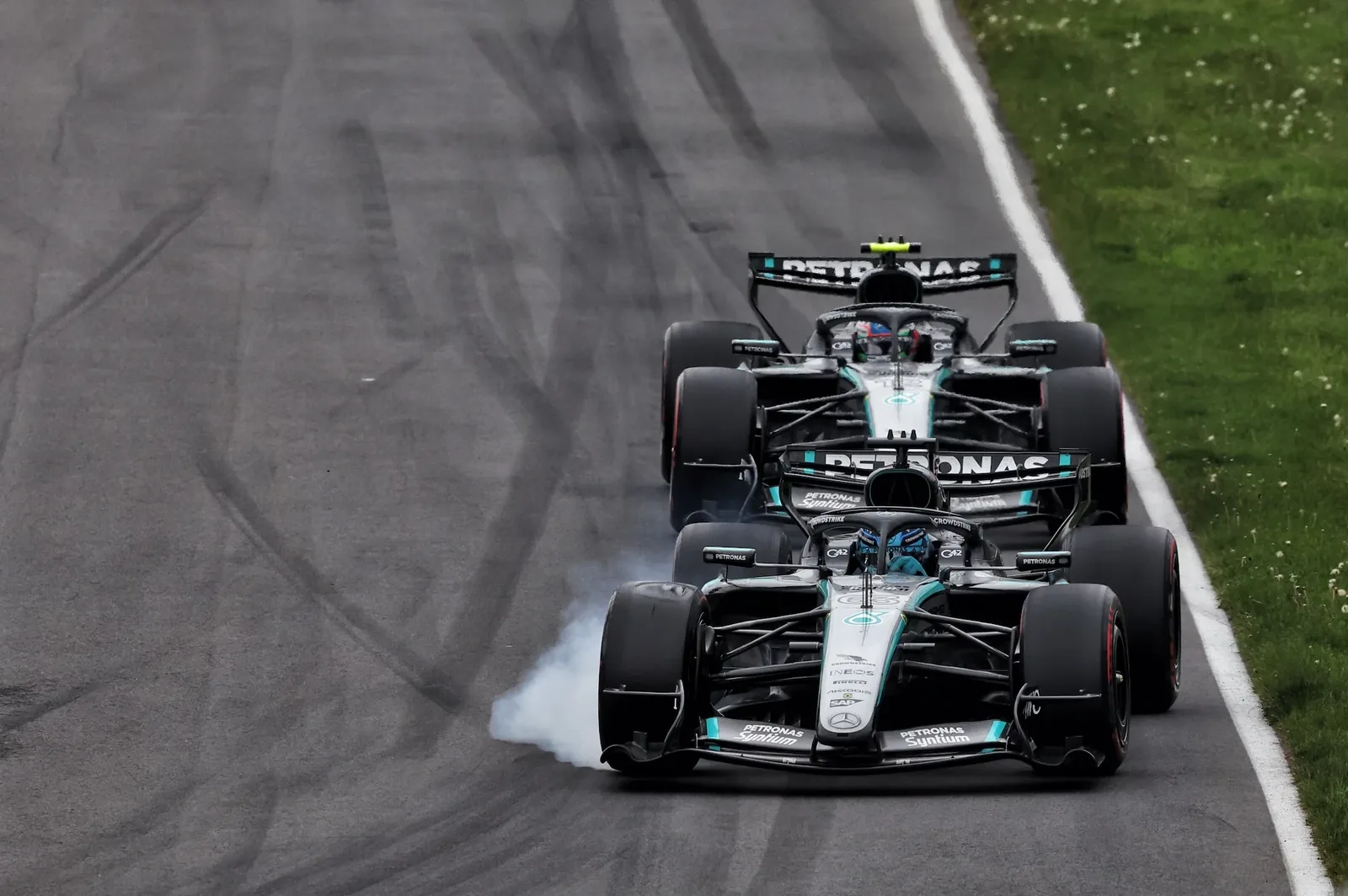
Team boss says the package introduced in the W17 did not match the projections made in simulators, but admits it is still early to assess its real impact.
Read more It’s Race Week! Monaco GP marks the sixth round of F1 2026
Mercedes left the Canadian GP with more questions than answers about the latest update package introduced in the W17. Despite a competitive weekend in Montreal, team boss Toto Wolff admitted that the novelties brought to the event did not produce the performance gains the team had projected.
The package presented at the Circuit Gilles Villeneuve was one of the most comprehensive of the season so far for the German team. The changes involved several areas of the car, starting with the front wing, which received a new configuration and revised endplates to improve airflow management. Mercedes also made changes to the front area of the car and focused much of the work on the floor, an area considered fundamental in the current generation cars.
Among the modifications were revisions to the floor edge, corner sections, and parts of the diffuser, aiming to increase downforce and improve the quality of airflow under the car. At the rear, the team also repositioned aerodynamic elements to optimize the airflow towards the back of the W17.
Despite the extensive development work, Wolff acknowledged that the results obtained in Montreal fell short of expectations.
Read more F1 today: Cadillac demands reaction and Mercedes regrets Russell
“It didn’t bring the performance gains we expected on paper, but it’s very difficult to assess. We didn’t see the McLarens at any point today. We had pace, we had an advantage, but it’s hard to know how much of that corresponds to what we had predicted. It’s still very early to judge,” the team principal told the press after the race.
According to Wolff, one of the difficulties in evaluating the package lies in the fact that Montreal historically favors Mercedes’ characteristics. The team had already shown competitiveness at the Canadian circuit last season, which makes it harder to separate the effect of the updates from the natural behavior of the car on a track that traditionally suits the team’s design well.
“Montreal was a very good circuit for us last year. Is that making our performance look better than it really is? Probably. In Monaco, we also won’t have a definitive answer. We need to keep monitoring and analyzing,” he added.
Mercedes intends to use the upcoming races to collect more data before reaching a conclusion about the effectiveness of the updates. With quite distinct characteristics among the circuits on the calendar, the team believes that only a long-term analysis will allow understanding if the package really represents progress in the fight against McLaren, Ferrari, and Red Bull throughout the 2026 season.
Read more NASCAR Brazil: Cacá Bueno closes stage with two podiums and victory at Interlagos