









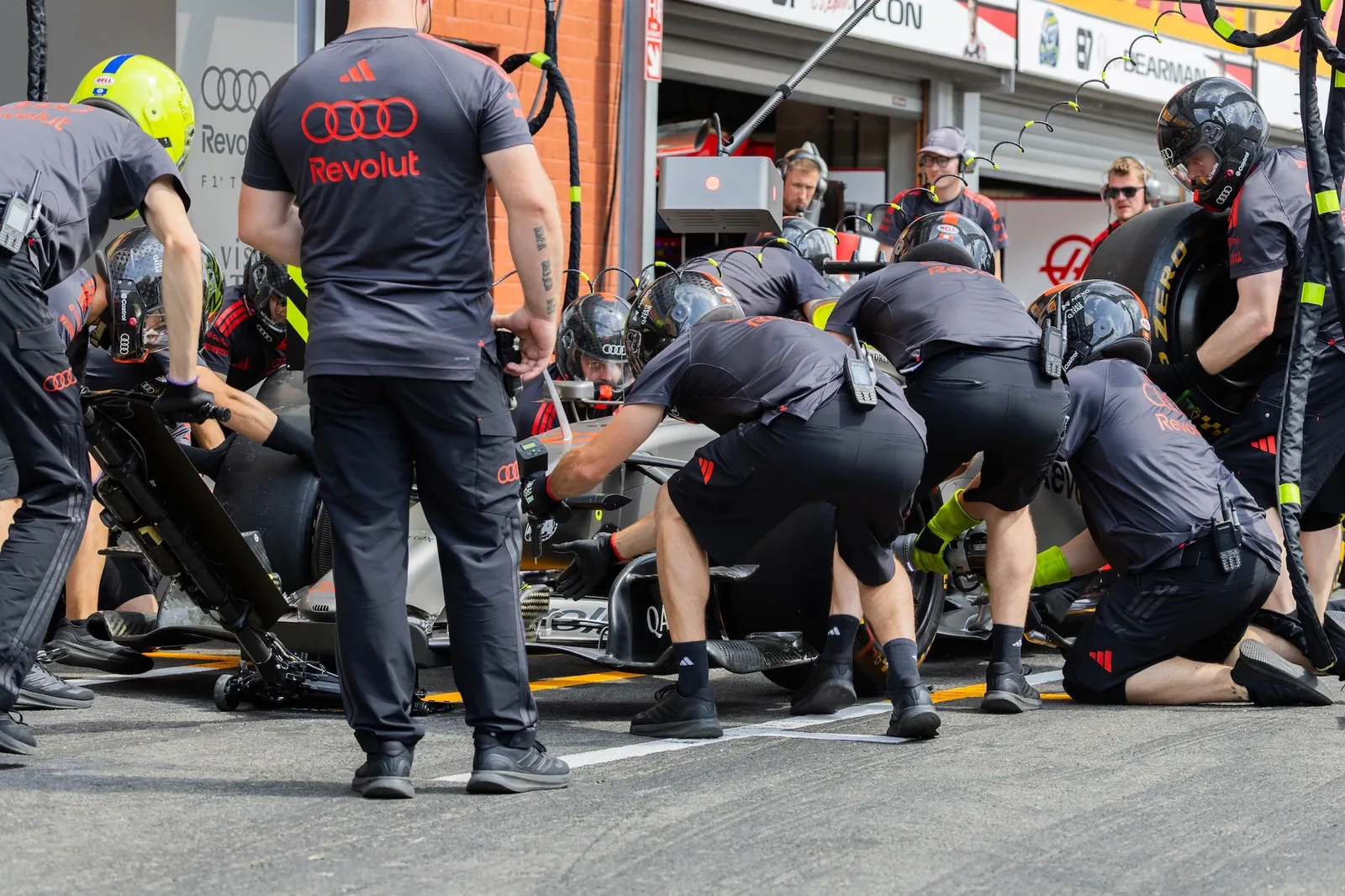
Gabriel Bortoleto’s team presented a single update in the FIA document, focused on the rear wing endplate for Budapest.
Read more F1: Bortoleto shows good pace and finishes sixth in TL1 of the Hungarian GP
Audi arrives at the Formula 1 Hungarian GP with only one update declared in the technical document released by the FIA for the Hungaroring round. Gabriel Bortoleto’s team presented a change to the rear wing endplate, focusing on local aerodynamic load gain and improving the car’s overall efficiency.

The update is specific, especially compared to teams that brought broader packages to Budapest. Aston Martin, for example, declared 16 new items, while McLaren appeared with five. Mercedes, Red Bull, and Racing Bulls also registered three updates each. In Audi’s case, the development for this round was concentrated on a specific area of the rear.
According to the FIA document, the team revised the profile of the rear wing endplate. In simple terms, this means a change to the vertical piece at the ends of the wing, used to help control the air passing through that region. The goal is to generate more local aerodynamic load and contribute to the overall efficiency.
At the Hungaroring, this type of adjustment can be important. The Hungarian track is tight, has many low and medium-speed corners, and requires a car with good aerodynamic support. Unlike Spa-Francorchamps, where drag reduction on the straights gains a lot of weight, Hungary usually values stability, traction, and the ability to maintain pace through a sequence of corners.
Read more F1: Several teams brought updates to Budapest
For Gabriel Bortoleto, the update can primarily help with the car’s rear behavior. On a track like the Hungaroring, confidence in the rear of the car is crucial for attacking long corners, changes of direction, and sections where the driver needs to carry speed without losing stability.
Still, Audi’s package is clearly smaller than that of several rivals. This does not, in itself, mean an absence of evolution, as a well-directed change can deliver useful gains on a particular track. But the document indicates that the team did not bring a comprehensive package of new parts to Hungary, unlike what happened in some previous rounds.
The Budapest round will therefore be another efficiency test for Audi. With only one declared update, the team’s performance will depend not only on the new rear wing endplate, but also on the car’s setup, tire management, and the ability to find balance on a track with high aerodynamic demands.
Didn’t understand any technical terms from the updates? See the F1 Mania glossary on Formula 1 aerodynamic parts and concepts.
Read more F1: Check out the full results of TL1 of the Hungarian GP 2026