







Red Bull Powertrains-Ford was once again pointed out by the FIA as a benchmark in combustion engine performance, but the numbers from the first twelve stages of the 2026 Formula 1 season tell a very different story. Cars equipped with Mercedes power units dominated race leadership.
Read more F1: Hadjar’s physical condition improves and Red Bull shows optimism for the Italian GP
In the second ADUO evaluation conducted by the entity, Red Bull Powertrains-Ford again appeared as a reference in the ICE, while Mercedes was between 2% and 4% behind this parameter. Ferrari was considered more than 4% below the benchmark set by the Red Bull Powertrains-Ford power unit.

However, on the track, Mercedes’ advantage is significant. Of the 745 laps contested in the lead throughout the first twelve races, cars equipped with their engines led 605, equivalent to 81.2% of the total. Ferrari appears second, with 132 laps and 17.7%, while Red Bull Powertrains-Ford totals only eight, 1.1%, and Honda and Audi have yet to lead a lap.
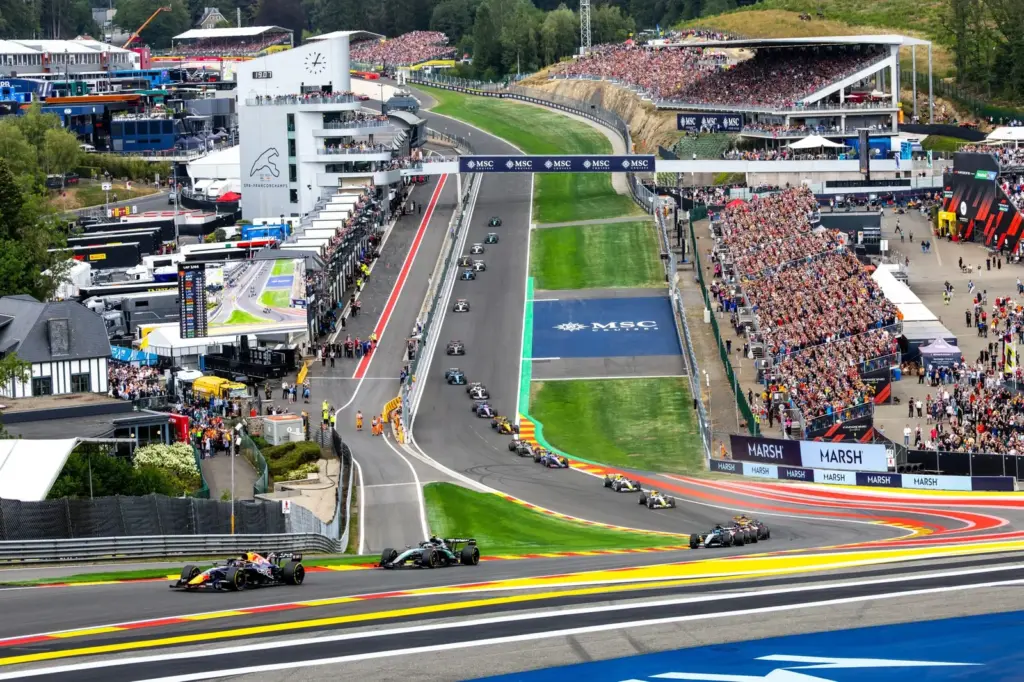
The numbers gain even more weight when considering reliability issues. Max Verstappen retired from four of the twelve races, in China, Monaco, England, and the Netherlands (in this case, due to his own error resulting in an accident), while Isack Hadjar had two retirements. Mercedes also faced difficulties, with three retirements between George Russell and Kimi Antonelli.
Read more F1: Gasly demands analysis after chaotic start in Zandvoort
McLaren, equipped with Mercedes engines, had six races without finishes between Lando Norris and Oscar Piastri, when retirements and non-started races are considered. Even with these occurrences, cars powered by Mercedes remained responsible for more than 80% of the laps led. Ferrari, on the other hand, recorded only two retirements, both with Charles Leclerc, while Lewis Hamilton finished all races so far.
This evaluation, however, does not allow concluding that the Mercedes power unit is superior to Red Bull Powertrains-Ford in absolute terms. A car’s performance also depends on the chassis, aerodynamics, tire management, reliability, and execution during the weekend, and it is precisely this difference between the ICE evaluation and the on-track results that makes the data from the first twelve stages particularly relevant.
Read more F1: Haas ends test without favorite between Câmara and rivals