




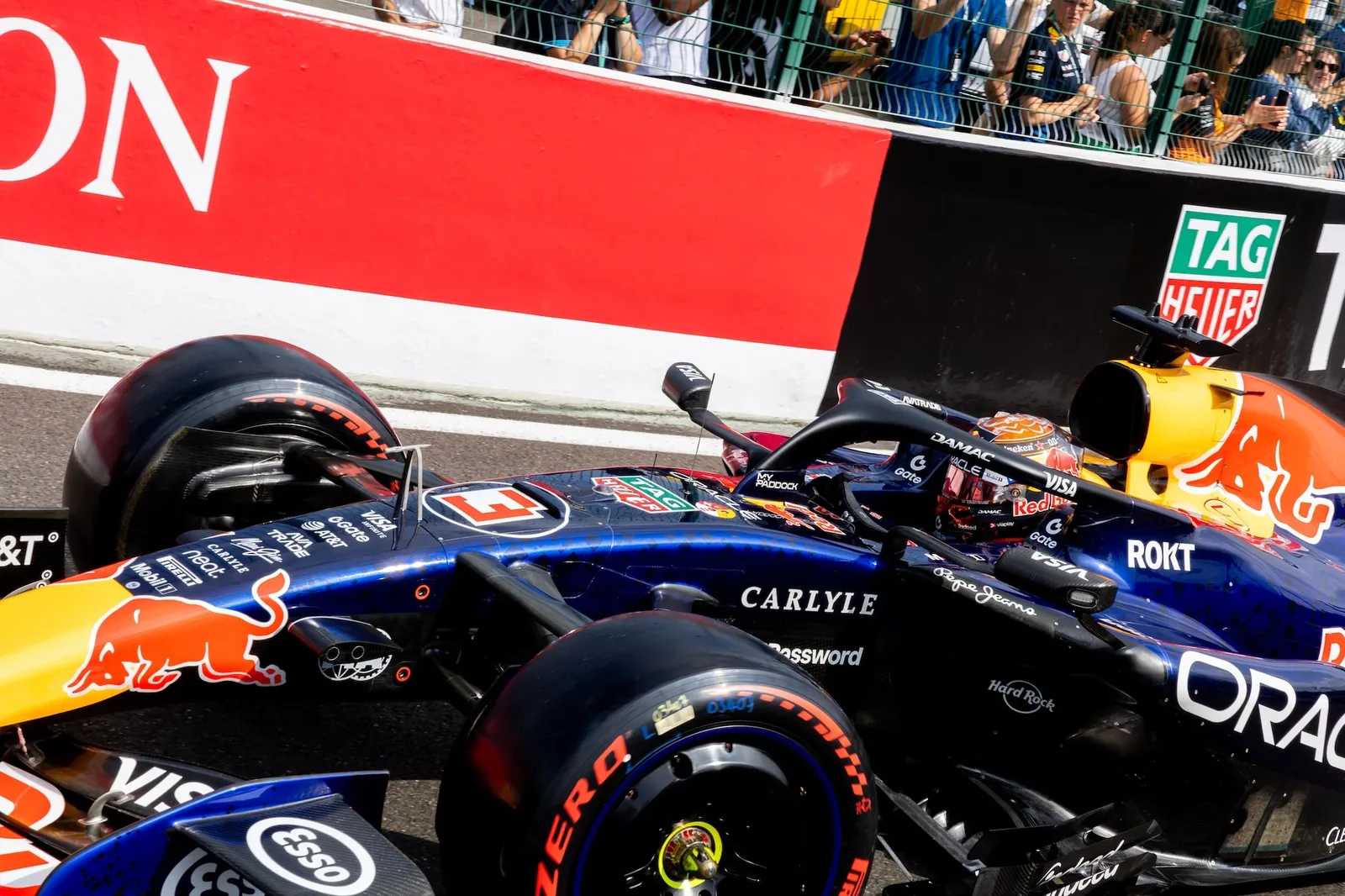
Team started the new era far from Mercedes, Ferrari, and McLaren and arrives at the break without wins or poles, but the recent evolution of the RB22 shows that chassis, power unit, and adaptation to the regulations need to be analyzed separately.
Read more F1 today: Mercedes prepares package and Red Bull aims for a comeback
Red Bull arrived at the 2026 Formula 1 break with a statistic that would have been practically unimaginable during the period it dominated the category: after 11 Grands Prix, it had not won any race or pole position.

There are 177 points in the Constructors’ Championship, against 379 for Mercedes, 307 for Ferrari, and 220 for McLaren. The team is only in fourth place. Its four podiums were achieved by Max Verstappen, while Isack Hadjar is still seeking his first top-three finish.
But summarizing the decline by simply saying Red Bull produced a bad car would be insufficient.
What happened in 2026 is deeper. The regulatory change removed the team from the technical environment in which it had developed part of its main advantages over the years. The RB22 was born under different aerodynamic concepts and, for the first time, Red Bull also started producing its own power unit in partnership with Ford.
In other words, Milton Keynes had to start simultaneously a new car and a new engine project.
And the first months showed that not all these pieces matured at the same speed.
The 2026 decline did not exactly start in 2026
There is an important nuance in comparison with the past.
Red Bull did not finish 2025 as the best team in Formula 1. It was only third among constructors, with 451 points, behind McLaren and Mercedes. But that classification hid an impressive recovery: Verstappen won six of the last nine races and finished the Drivers’ Championship just two points behind the champion.
Therefore, the expectation for 2026 was not necessarily for the continuation of a dominance that had already ended.
It was that the team could carry over to the new generation the technical capacity demonstrated during the recovery in the second half of 2025.
The tests themselves started with an interesting contrast.
The new Red Bull Ford surprised positively. Pierre Waché described the work done by the engine division as “remarkable” and highlighted the fact that Red Bull had built a power unit from scratch in approximately three and a half years. At the same time, the technical director already placed the team only as the fourth force at that moment, behind Mercedes, Ferrari, and McLaren, and identified the car’s balance as an area that needed to evolve.
It was a first indication of what was to come.
In Australia, Verstappen finished only sixth and Hadjar retired. In China, the Dutchman suffered an ERS failure and did not finish the race, while Hadjar was eighth. In Japan, Verstappen finished only eighth and the Frenchman 12th. After the first three rounds, Red Bull had only 16 points and was sixth among constructors.
More important than the results were the symptoms.
Verstappen complained about the engine, balance, understeer, and oversteer. Hadjar was also not satisfied. Laurent Mekies was particularly careful when explaining the situation after Japan: there was no single area that could be pointed out as responsible for the problems.
This may be the key to understanding Red Bull in 2026.
There was no dominant failure.
There were several small deficiencies acting simultaneously.
The engine became the easiest explanation, but not necessarily the correct one
The debut of Red Bull Ford naturally received enormous attention.
For years, Red Bull bought or used power units produced by other manufacturers. In 2026, it effectively became a full manufacturer, building the car and engine within the same project.
It was reasonable to imagine that the biggest difficulty would be precisely there.
The first months showed a more complex reality.
Problems existed. Verstappen retired in China due to an ERS-related failure. Hadjar faced power and deployment difficulties on different occasions. In Monaco, he complained during the race about lack of power and gearbox problems. In Canada, he also faced problems during the Sprint.
But that does not mean the Red Bull Ford unit was the main reason for the loss of competitiveness.
Before Hungary, Verstappen even praised the engine project work directly, saying that what the engineers had designed before the start of the season had largely been confirmed on track. The internal reading was that the power unit had started better than could be expected from a rookie manufacturer.
The problem is that 2026 made engine, energy recovery, deployment, chassis, and aerodynamics even more interdependent.
A straight-line speed deficiency can come from power, but also from the amount of drag the car needs to carry. A difficulty in recovering energy can alter electrical availability in another part of the lap. An unstable car can force the driver to compromise corner entries and exits, affecting the entire energy cycle.
Therefore, Red Bull itself avoids attributing its situation exclusively to the engine.
And Verstappen offered perhaps the simplest diagnosis before Silverstone.
According to him, there is no single area where the RB22 is weak. In some situations, performance is lacking at low speed; in others, at high speed. There are also balance and setup issues.
Barcelona made this particularly visible.
Red Bull knew before the weekend that a circuit with a long straight and fast corners would expose some of its weaknesses. Verstappen qualified fifth and Hadjar sixth. In the race, they repeated fourth and sixth places respectively.
After the race, the team’s assessment was that about four or five tenths were still missing to fight for victory on that type of track.
In Monaco, on the other hand, Hadjar finished fourth, his best result of the year.
The differences between these circuits help show why defining the problem simply as “engine” or “aerodynamics” would be misleading.
The RB22 started the year with a limited operating window. Depending on the combination of corner speed, aerodynamic load, available energy, and track characteristics, its limitations appeared in different ways.
Verstappen improves the picture, but Hadjar shows the car is not just a creation for Max
Another element makes the reading of Red Bull particularly interesting.
Verstappen continues to be able to produce results above expectations on certain weekends.
He has 109 points and is sixth in the World Championship. Hadjar has 68 and is eighth. The Dutchman leads the internal comparison 8 to 3 in qualifying and exactly 8 to 3 in races.
It is also Verstappen who is responsible for the team’s four podiums: third in Canada, second in Austria, third in Spa, and second in Hungary.
It is tempting to conclude, therefore, that the four-time world champion is simply masking a car much worse than his results suggest.
Read more F1: Norris says he has changed his driving style «every year of my life»
There is some truth in that, but Hadjar prevents the analysis from ending there.
The Frenchman is not completely lost with the RB22.
After an irregular start, Hadjar began a quite solid sequence: fifth in Canada, fourth in Monaco, sixth in Barcelona, sixth in Austria, fifth in Silverstone, sixth in Spa, and again sixth in Hungary.
In Silverstone, he even qualified two positions ahead of Verstappen. His performance was later affected by a front wing problem that cost a huge amount of aerodynamic load; after the part was replaced, his times improved by almost two seconds.
Hadjar also acknowledged before the break that the RB22 is not an easy car, but said he can understand it and extract its potential with much more consistency than at the start of the championship. His comparison point is also revealing: he believes he has good performance in a flying lap but sees a much bigger difference in Verstappen’s race management.
This helps separate car from driver.
The RB22 has real limitations.
Verstappen manages to compensate for some of them better than Hadjar, especially throughout races.
But the Frenchman’s recent performance also shows that the car is not simply an impossible machine to drive for anyone other than the four-time champion.
It is a car that started badly and is being gradually expanded in its operating window.
The difference between the drivers remains relevant, but it does not explain the 202 points that separate Red Bull and Mercedes.
It also does not seem correct to put the race operation as the main cause.
The team made mistakes and suffered technical problems, especially at the start of the year, but there were weekends when it executed very well without having the fastest car. In Spa, for example, Hadjar started from the back of the grid and finished sixth with the help of an aggressive strategy, while Verstappen qualified second – also benefiting from a slipstream offered by his teammate – and finished on the podium.
Execution can extract more from the package.
It cannot turn this package into something it is not yet.
Austria showed that Red Bull may have already found the way
If the first three races represent the worst picture of the season, Austria represents the most important one.
Before the GP in Spielberg, Red Bull brought an extensive update package to the RB22, with changes to the floor, rear suspension, rear area, wing, exhaust, sidepods, and engine cover. Part aimed at performance; another part sought to improve reliability and cooling aspects.
The leap was significant.
Mekies stated that Red Bull had started the championship more than a second off the pace of the front, reduced that difference to about half a second with the Miami package, and in Austria reached the region of the last tenth. It was an estimate from the team itself, not a universal measure applicable to any circuit, but it helps visualize the development trajectory.
Verstappen finished the race second, only 0.3 seconds behind Russell.
It was the first moment in 2026 when Red Bull really seemed capable of winning a race by performance.
Hadjar finished sixth.
Silverstone interrupted Verstappen’s streak with a retirement after balance and wing problems, but the car’s speed continued to show. In Spa, he returned to the podium. In Hungary, he finished second again.
The cut is important.
In the first seven races, Verstappen achieved only one podium.
In the last four before the break, he stood on the podium three times.
That does not mean Red Bull has caught up with Mercedes.
It means it stopped seeming permanently stuck behind the top four teams.
There is another revealing detail.
In Spa, Verstappen acknowledged that the RB22 was in a good window and with reasonable balance, but still complained about straight-line speed. His second position in qualifying also depended significantly on the slipstream provided by Hadjar.
In other words: even during the recovery, the limitations did not disappear.
They just became smaller.
And Hungary confirmed this trend. Verstappen started fourth and finished second, but Norris won with a 15.080-second advantage. Red Bull managed to place a car between McLaren and Mercedes in the final result without having shown the pace to control the race.
It is exactly this difference that still separates a recovering team from a championship contender.
Mercedes won eight races and ten poles in the first 11 rounds.
Red Bull won none.

So, what really happened to Red Bull?
The answer starts with what did not happen.
There is not enough evidence to state that Red Bull simply got the engine wrong.
Red Bull Ford had reliability and energy management problems, as could be expected from a completely new project, but its initial performance was considered internally better than the car’s own result.
It would also be simplistic to blame only the chassis.
The RB22 was born with balance problems, a restricted operating window, and deficiencies that varied between low and high speed. However, the performance in Austria, Spa, and Hungary shows that the base accepts development.
The operation also does not explain everything.
And Verstappen, despite continuing to extract more from the car than Hadjar on most weekends, cannot alone eliminate technical differences of several tenths.
What happened was a combination.
The regulation change erased part of the accumulated knowledge that supported Red Bull’s greatest strengths in the previous cycle. At the same time, the team took full responsibility for its own power unit for the first time. Chassis, aerodynamics, energy management, and engine needed to mature together, and they did not mature at the same pace.
While Mercedes started 2026 with a package already very close to its ideal window, Red Bull spent the first races trying to figure out which problems it needed to solve first.
This initial difference was costly.
After 11 races, there is a 202-point deficit to Mercedes in the Constructors’ Championship and 110 between Verstappen and Antonelli in the drivers’ standings.
But there is a second half to this story.
The RB22 that finished second in Austria, third in Spa, and second in Hungary is no longer competitive in the same way as the car that finished eighth in Japan.
Red Bull found performance.
The challenge after the break will be to make it less dependent on the circuit and Verstappen’s exceptional talent.
To really return to the group of teams capable of fighting championships, it needs to expand the RB22’s window, reduce its weaknesses at high speed and on straights, continue improving Red Bull Ford’s energy management, and turn the progress of updates into reproducible performance.
The new era did not destroy Red Bull.
It destroyed some of the technical certainties that the team had taken years to build.
The first half of 2026 was dedicated to figuring out how to replace them.
The last rounds indicate that the team has finally started to find some answers.
Read more F1: Honda denies rumor of 50 hp extra in Aston Martin engine